AI Blogging
AI Blog Post Outlining System: The 4-Part Framework for Long-Form SEO Content
A practical AI blog post outlining system that structures long-form SEO content before drafting — 4 steps from keyword intent to section briefs that write themselves.
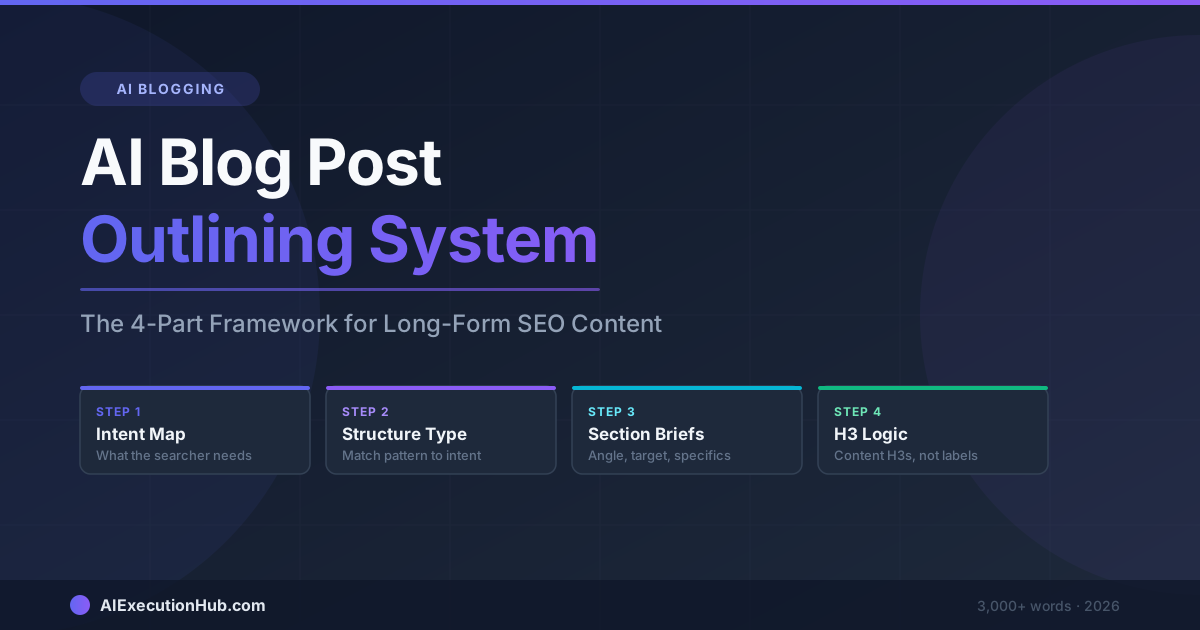
Most AI outlines look the same: an intro, five H2 sections with interchangeable subpoints, and a conclusion that summarizes what you just read. That structure is not the result of careful thinking about search intent or competitive gaps. It is what AI produces when you give it a keyword and no other instructions.
The problem is not AI. The problem is asking AI to do two things at once — invent the structure and fill it — with no system guiding either step.
This guide covers a 4-part AI blog post outlining system that separates structure decisions from drafting decisions. The result is an outline specific enough that each section brief practically writes itself — and AI fills in content rather than making things up to pad a generic skeleton.
What an AI blog post outlining system actually is
An AI blog post outlining system is a repeatable process for producing a complete content structure before you write a single word of the draft.
The distinction matters. Most people think of outlining as a quick step before the real work begins. In an effective AI blogging workflow, the outline is the real work. A strong outline means the drafting phase is execution, not decision-making. A weak outline means you spend the drafting phase restructuring, cutting dead sections, and filling gaps the AI invented to meet a word count.
A complete outlining system has four components:
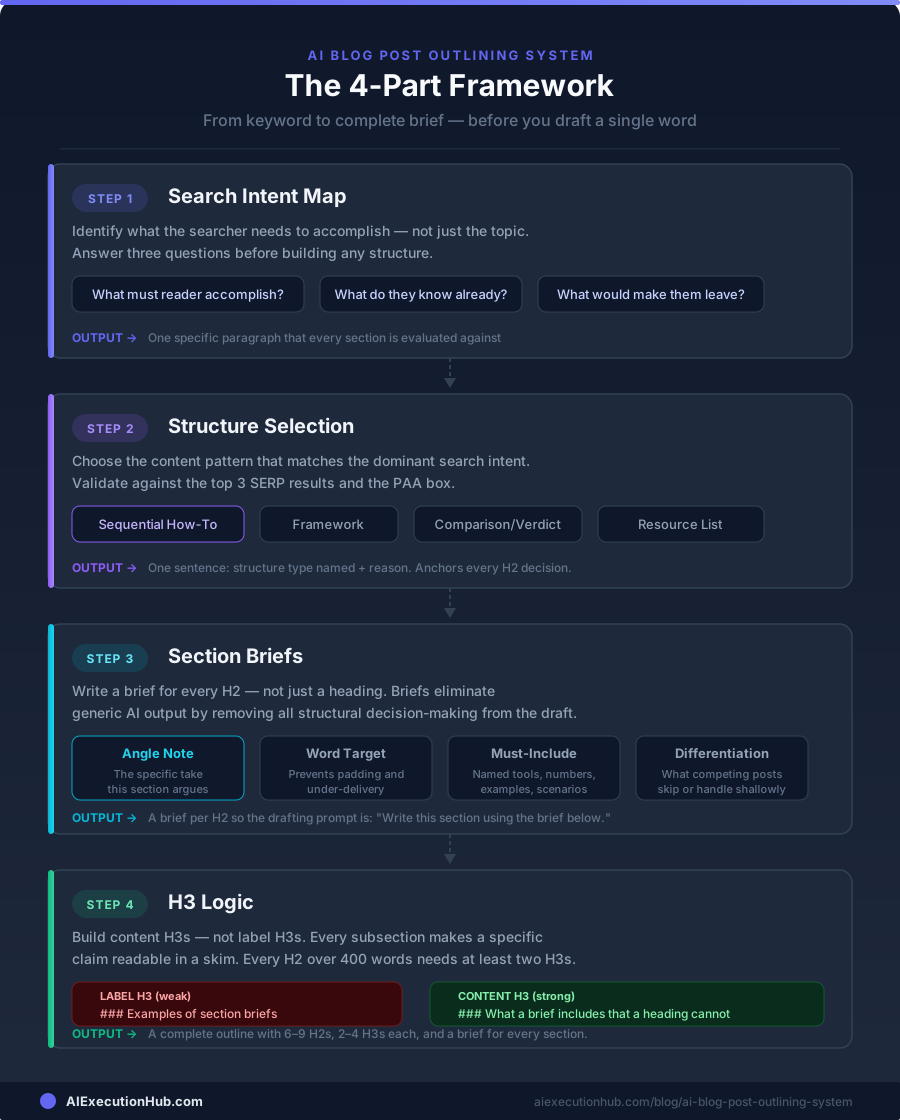
- Search intent map — what the searcher actually needs to walk away with
- Structure selection — which content pattern matches that intent
- Section briefs — angle note, word target, and specifics for each H2
- H3 logic — the internal breakdown that makes each section scannable
Running all four before opening your drafting tool means AI fills in a defined container rather than constructing one from scratch. That is the difference between a first draft that needs light editing and one that needs to be torn down and rebuilt.
Why one-shot prompting produces bad outlines
The fastest way to get a bad outline from AI: paste in a keyword and ask for an outline.
What comes back is a structure that reflects the most common pattern in AI training data for that topic — which, for most informational keywords, is some variation of:
- What is [topic]
- Why does [topic] matter
- How to [topic] in 5 steps
- Tools for [topic]
- Common mistakes
- Conclusion
This structure is not wrong. It is just not differentiated from the dozens of other posts using the exact same skeleton. When every post on the SERP is structured the same way, none of them have a structural advantage. The sites that rank on competitive keywords are almost never the ones with the most generic outline — they are the ones whose structure most precisely matches what the searcher needs and delivers it with more specificity.
One-shot outlining fails on three specific dimensions:
No intent analysis. The keyword "AI blog post outlining system" can be answered with a definition, a step-by-step guide, a prompt template library, or a comparison of different structural approaches. Each angle produces a different outline. A one-shot prompt picks one arbitrarily.
No structure selection. Different search intents require different structural patterns. A how-to keyword needs a sequential step structure. A comparison keyword needs a verdict-per-dimension structure. Using a how-to structure on a comparison keyword, or a framework structure on a how-to keyword, produces a post that technically covers the topic but feels off to readers — because it answers a different version of the question than the one they actually asked.
No section briefs. A list of H2 headings is not enough information for AI to draft useful sections. Without angle notes and specificity targets, AI fills each section with the generic version of that topic — which is exactly the content the editing pass will have to strip and replace.
The outlining system below fixes all three.
The 4-part AI blog post outlining system
Part 1: Search intent map
Before choosing any structure, identify exactly what a person who searches this keyword needs to accomplish.
There are four intent types for informational keywords:
| Intent type | What the searcher needs | Example signal in the keyword |
|---|---|---|
| Learn | Understand a concept or process | "what is", "how does", "explained" |
| Do | Complete a specific task | "how to", "step by step", "guide" |
| Decide | Choose between options | "vs", "best", "which", "comparison" |
| Reference | Get a reusable tool or template | "template", "checklist", "examples", "prompts" |
Most long-tail informational keywords are a combination of two intents. "AI blog post outlining system" is primarily Do (how to build and run the system) with a secondary Learn component (what the system consists of and why it works). That combination determines the structure: a framework post with sequential steps, not a pure definition post or a pure how-to.
To map the intent for any keyword, ask three questions:
- What does the reader need to be able to do after reading this post?
- What do they know at the start, and what do they need to know at the end?
- What would make them close the tab and look for a different result?
That third question is the most useful. If a post opens with two paragraphs of context the reader already has, they close the tab. If a post never gets to the specific system the keyword promised, they close the tab. Intent mapping is about knowing the exact threshold where the reader goes from "this is what I was looking for" to "this is not quite right."
Write the intent map as one paragraph before building the outline. It does not need to be long. It needs to be specific enough that every section in the outline can be evaluated against it.
Intent map for this keyword:
The reader is a blogger using AI tools for content production who wants a repeatable system for structuring posts before drafting — not a general "how to write a blog post" guide, not a prompt template library. They need to understand why the system exists, what the four parts are, how to execute each one, and what bad outlining looks like so they can avoid it. They will leave if the post is another generic "write an outline before you draft" article with no actual system attached.
Every H2 in the outline should earn its place against that intent map.
Part 2: Structure selection
Once the intent is mapped, choose the content structure type that delivers it most directly.
There are four structures that cover the majority of long-form informational posts:
Sequential how-to. Steps in a fixed order where each step depends on the previous one. Right for procedural keywords where the reader needs to execute a process. Wrong for concept-heavy posts where the steps can be taken in any order or where understanding the framework matters more than execution sequence.
Framework. A named system with defined components that the reader applies to their situation. Right for "system" and "method" keywords, for posts that need to teach a mental model, and for topics where the parts interact rather than flow sequentially. This is the right structure for "AI blog post outlining system."
Comparison/verdict. Side-by-side evaluation of options with a clear recommendation per dimension. Right for "vs" and "best" keywords. Wrong when the reader does not need to choose between things — a common mistake is writing a comparison post for a keyword that is actually a how-to.
Resource list. A curated set of tools, examples, templates, or references with consistent evaluation criteria for each item. Right for "best [thing]" keywords where the reader needs options with context. Wrong when depth on one topic matters more than breadth across multiple topics.
The structure is a strategic decision, not a formatting one. Two posts with identical word counts and keyword placements will perform very differently on the same keyword if one uses the right structure for the intent and one does not.
Write the structure choice as a single sentence in your outline header: "Framework post with sequential execution steps" or "Comparison post, verdict-per-task structure." That one sentence keeps every section decision anchored to the right pattern.
Part 3: Section briefs
A section brief is a one-paragraph note for each H2 that tells AI exactly what to write — not just what the section is about, but what angle it takes, what it needs to include, and what makes it different from the generic version.
A section brief has four parts:
- Angle note — the specific take this section argues or demonstrates (not just the topic)
- Word target — how long the section should be (prevents padding and under-delivery)
- Must-include specifics — any data points, examples, named tools, or concrete scenarios that must appear
- Differentiation note — what this section does that the competing posts on this keyword do not
Here is the difference between a heading and a brief:
Heading only:
Why one-shot outlining fails
With a section brief:
Why one-shot outlining fails
Angle: The failure is structural, not a tool limitation — AI produces generic output when given no constraints. This section should make the reader feel the specific problem before presenting the system. Word target: 350–450 words Must include: The default AI outline pattern (What is / Why / How-to / Tools / Mistakes / Conclusion), and why that pattern is identical across competing posts Differentiation: Name three specific dimensions where one-shot outlining fails — intent, structure, briefs — not just "AI gives generic output"
When you feed a section brief to AI instead of just a heading, the output is immediately more specific and requires less editing. The brief removes the decision burden from the drafting step.
Write section briefs for every H2, including the intro and FAQ. The intro brief is especially important — it should specify the hook, what problem the intro frames, and what the reader needs to believe by the time they reach the first H2.
Part 4: H3 logic
H3 subsections do two jobs: they make long sections scannable, and they signal to search engines the specific sub-topics covered within each H2.
The most common outlining mistake at the H3 level is using H3s as labels rather than as content decisions. A label H3 is a title that describes what comes next ("Overview," "Examples," "Tips"). A content H3 is a title that makes a specific point or covers a specific aspect of the parent H2 that can stand alone.
Label H3 (weak):
Examples of section briefs
Content H3 (strong):
What a section brief includes that a heading alone cannot tell AI
The content H3 signals to the reader — and to search engines — exactly what the subsection delivers. It can be read in a skim and still communicate the post's argument.
For long-form posts of 2,500 words or more, build the H3 logic before drafting. The rule of thumb: every H2 with more than 400 words needs at least two H3s. Every H3 should cover a distinct point that does not overlap with the others.
The H3 logic is also where you embed long-tail keyword variations naturally. The parent H2 targets the primary keyword. The H3s cover the sub-topics that appear in related searches, PAA questions, and auto-complete variations — all without keyword stuffing, because the H3s reflect real structural decisions rather than forced placements.
Choosing the right outline structure for your keyword intent
The fastest way to misuse this system: apply the framework structure to every keyword regardless of intent. Structure selection is not a preference — it is a match problem.
Here is how to read the SERP to validate your structure choice before writing a single section brief:
Check the top 3 results. What structure do they use? If all three use a sequential how-to and you are planning a comparison post, you are either discovering a genuine differentiation opportunity or misreading the intent. Investigate before committing.
Check the People Also Ask box. PAA questions signal the sub-intents that Google has mapped to this keyword. If most PAA questions are "how do I..." formulations, the dominant intent is Do. If most are "what is the difference between..." formulations, the dominant intent is Decide.
Check the featured snippet. If there is a featured snippet, its format tells you what Google has concluded answers the query best. A numbered list snippet favors a sequential how-to. A paragraph snippet favors a framework or definition structure. A table snippet favors a comparison.
Match, then differentiate. Use the structure that matches intent — and then differentiate at the section brief level, not the structure level. Choosing an unconventional structure to stand out from competitors usually backfires. The differentiation that actually wins comes from more specific section briefs, not from restructuring the post type entirely.
Prompts for each outlining stage
These are the prompts that correspond to each part of the system. Use them in order, with the output of each stage as the input for the next.
Stage 1 — Intent map prompt:
"I am writing a blog post targeting the keyword '[keyword]'. Before I outline, I need to map the search intent precisely. Tell me: (1) What does a reader searching this keyword need to accomplish after reading the post? (2) What do they likely know already, and what do they need to leave knowing? (3) What would make them close the tab and search again? Give me a one-paragraph intent summary I can use to evaluate every section I add to the outline."
Stage 2 — Structure selection prompt:
"Based on this intent map: [paste intent map]. The four structure types for long-form informational posts are: sequential how-to, framework, comparison/verdict, and resource list. Which structure best delivers the intent described above? Give me one sentence explaining the choice and one sentence explaining what structure to avoid and why."
Stage 3 — Section brief prompt:
"I am writing a [structure type] post on '[keyword]'. Here is the intent map: [paste]. Here are the H2 sections I am planning: [paste headings]. For each H2, write a section brief that includes: (1) a one-sentence angle note, (2) a word target, (3) two or three must-include specifics, and (4) one differentiation note explaining what this section does that competing posts on this keyword typically do not."
Stage 4 — H3 logic prompt:
"Here is the section brief for the H2 '[section heading]': [paste brief]. Write 2–4 H3 subsections for this section. Each H3 should cover a distinct point that can be understood by a reader who skims only the heading. Avoid label H3s (like 'Examples' or 'Tips') — each H3 should make a specific claim or cover a specific aspect."
Run these prompts sequentially in a single conversation so the context from each stage carries into the next. Do not jump to Stage 3 without Stage 1 output — the section briefs will default to generic without the intent map anchoring them.
How to brief each section so the draft writes itself
The goal of a section brief is to reduce the AI drafting prompt to near-zero decision-making. If the brief is complete, the drafting prompt is: "Write this section using the brief below."
A complete section brief for a 3,000-word post takes about 45–60 minutes to write. That time investment pays off in the drafting phase — a well-briefed 3,000-word post drafts in 60–90 minutes with one AI session per section. A post with only headings and no briefs takes the same 60–90 minutes just to restructure the first draft.
The practical test for a complete section brief: read only the brief, with no knowledge of the post topic. Would you know exactly what to write? If the answer is no, the brief is not specific enough.
Common gaps in incomplete section briefs:
Missing word target. Without a word target, AI writes to fill a perceived space — often padding to 600 words a section that needed 300, or under-delivering on a section that needed 600. Set the word target based on the complexity of the section, not the desired total word count divided by section count.
No angle note. "This section covers X" is not an angle. "This section argues that X is the root cause, not Y — and uses a concrete before/after example to demonstrate" is an angle. The angle note is what separates a useful section from a generic one.
Missing differentiation note. If you cannot articulate what your section does that competing posts do not, the section is almost certainly going to produce generic AI output. Research the top three competing posts on the keyword before writing section briefs, and note specifically what they cover shallowly or skip entirely.
No specifics flagged. If the section should include a specific tool name, a real process step, a concrete time estimate, or a named example, list it in the brief. AI will not invent the right specific — it will invent a plausible-sounding one, which is worse.
The outlining checklist before you draft
Use this before moving from the outline phase to any AI drafting prompt.
Intent map
- Written as a specific paragraph, not a keyword restatement
- Answers: what the reader needs to do, what they know at the start, what would make them leave
- Used to evaluate every H2 in the outline
Structure selection
- Structure type named and justified in one sentence
- Validated against SERP format of top 3 results
- PAA questions checked and mapped to H3 candidates
Section briefs
- Every H2 has an angle note (not just a topic description)
- Every H2 has a word target
- Every H2 has at least one must-include specific (example, tool, number, scenario)
- Every H2 has a differentiation note
- Intro brief includes the hook and the problem framing
- FAQ brief includes 6–8 PAA-sourced questions
H3 logic
- Every H2 over 400 words has at least two H3s
- All H3s are content H3s, not label H3s
- H3 set covers the full scope of the parent H2 without overlap
Internal linking
- 3–5 existing posts identified for internal links
- Anchor text phrasing noted in section briefs where links will appear
- At least one internal link target included in the intro or first H2
Common outlining mistakes that hurt ranking
Building the outline before mapping intent. The most expensive mistake in terms of wasted editing time. An outline built without an intent map often covers the right topics in the wrong order, or covers the wrong topics entirely, because the structure reflects what seems logical rather than what the searcher needs.
Using heading count as a quality signal. A 12-H2 outline is not better than a 7-H2 outline. Fewer, better-briefed sections consistently outperform longer outlines with thin briefs. The word count comes from the depth of each section, not the number of sections.
Treating the FAQ as an afterthought. FAQ sections are high-value real estate for People Also Ask ranking. A FAQ added without research — just generic questions the writer assumes people ask — misses the specific phrasing that actually appears in PAA boxes. Source FAQ questions directly from the PAA results for the target keyword, plus auto-complete variations and related searches.
Copying competitor outlines. Analyzing competitor structure is useful for understanding what works. Copying it produces a post with no structural differentiation. Use competitor outlines to identify gaps — sections they skip, angles they handle shallowly, specifics they avoid — not as a template.
Skipping the H3 logic and leaving it to AI. When you leave H3 structure to AI, it defaults to label H3s. "What is X," "Why X matters," "How to do X," "Common mistakes with X" — the same sub-pattern applied to every section. Content H3s require deliberate decisions about what each sub-section argues, which cannot be delegated to AI without explicit brief instructions.
Not updating the outline when research changes. It is common to start an outline, then discover a data point or competitor angle during the briefing phase that should change the structure. Most people push through rather than revising. A revised outline that takes 20 extra minutes saves 2 hours of mid-draft restructuring.
Putting the system into a repeatable production run
The four-part system takes longer the first time than the one-shot approach. By the third or fourth post, the intent mapping and structure selection steps take under 15 minutes combined — because you have seen the patterns enough to recognize them immediately.
The briefing step always takes time. That time is the point. It is the step where the human makes the decisions that distinguish the post from its competitors. AI handles execution. The outlining system is where strategy happens.
For a complete picture of how outlining fits into the broader production workflow — from keyword research through publishing and internal linking — the AI blogging workflow for beginners covers every stage in sequence, with the outlining step positioned at Step 3 in a seven-step pipeline.
For the tool question — whether Claude or ChatGPT produces better outlines in practice, and when to use each — the Claude vs ChatGPT for SEO blogging comparison covers the outlining task specifically, with a clear verdict and the practical workflow for using each tool's strengths at different stages.
Once the outline is complete and the draft is written, the next step is the editorial pass that transforms the draft into content worth publishing. The how to humanize AI content for SEO guide covers the five editing steps — stripping generic, adding specifics, injecting point of view, fixing flow, and verifying claims — in the order they should be applied.
For the full 16-stage production system that connects outlining, drafting, editing, SEO, schema, internal linking, and monetization into one pipeline, the Ultimate AI Blogging System 2026 Edition covers the complete architecture.
FAQ: AI blog post outlining system
What is an AI blog post outlining system?
An AI blog post outlining system is a repeatable process for structuring a blog post before drafting — starting with search intent analysis, choosing the right content structure type, writing section briefs with word targets and angle notes, and building the H3 logic within each section. The system gives AI a complete structure to fill rather than asking it to invent the structure from scratch.
Why does one-shot AI outlining produce bad results?
One-shot prompting asks AI to invent the structure, the angle, and the section logic simultaneously with no constraints. AI defaults to the pattern it has seen most often in training data — a generic listicle or intro-body-conclusion skeleton that does not reflect the actual search intent, competitor gaps, or the specific depth a long-form SEO post needs.
How do you write an outline for a 3,000-word blog post using AI?
Start by mapping the search intent — what the searcher needs to accomplish after reading the post. Choose a structure type that matches the intent. Write section briefs for each H2, including a one-sentence angle, a word target, and any specific examples or data points to include. Then build the H3 logic within each section before opening the AI drafting tool.
What should a blog post outline include for SEO?
An SEO blog post outline should include the target keyword in the first H2, a clear content structure type that matches the search intent, H2 sections that cover all angles a top-ranking post would address, H3 subsections that break down each H2 into scannable parts, and a FAQ section targeting People Also Ask queries. Every section should have an angle note that distinguishes it from competing posts.
How long should a blog post outline be?
A blog post outline for a 2,000–3,000 word post should include 6–9 H2 sections, 2–4 H3s under each H2, and brief angle notes for each section. The outline itself typically runs 400–600 words. Longer outlines are not necessarily better — the goal is enough specificity that the drafting prompt does not need to invent anything.
Can AI write a good blog post outline?
AI can write a usable first-draft outline if given the right constraints — the target keyword, the search intent, the content type, and any specific angles or data points to include. Without those constraints, AI defaults to a generic structure. The four-stage prompting sequence in this guide gives AI the input it needs to produce an outline worth drafting from.
What is the difference between a content brief and a blog post outline?
A blog post outline defines the structure — which H2s and H3s appear in what order. A content brief adds the editorial layer — angle notes, word targets, competitor gaps, tone guidance, and internal link targets for each section. The best AI outlining systems produce both simultaneously: the structure and the brief for each section in one document.
How do I choose the right outline structure for my keyword?
Match the structure to the dominant search intent. How-to keywords need a sequential step structure. Comparison keywords need a side-by-side or verdict structure. Definition or concept keywords need a framework structure that builds understanding progressively. Resource-list keywords need a curated set with evaluation criteria. Using the wrong structure type for the keyword intent is one of the most common reasons well-researched posts underperform on search.
Next steps
The outlining system above is the most leverage-producing step in the AI blogging pipeline. A complete, well-briefed outline makes every subsequent step — drafting, editing, SEO, internal linking — faster and more predictable.
The logical next step depends on where you are in the workflow. If you are building the full production pipeline from scratch, the AI blogging workflow for beginners places outlining in context with the six other stages that take a post from keyword to published. If you are already producing content and want to systemize all 16 stages — including content refresh, schema markup, and monetization layer — the Ultimate AI Blogging System 2026 Edition covers the complete architecture.
For the income side — connecting the content system you are building to a first real revenue stream — the First $100 With AI ebook covers the exact monetization steps that turn consistent AI-assisted content into an actual income, including the pieces most beginner guides leave out entirely.
Related AI systems
Continue with connected AI workflow guides.
Claude vs ChatGPT for SEO Blogging: A Task-by-Task Verdict
Claude vs ChatGPT for SEO blogging — a task-by-task breakdown of which AI wins for outlines, meta descriptions, tone editing, internal linking, and more.
AI Content Calendar for Niche Sites: A Practical Planning System
Build an AI content calendar for your niche site — keyword clustering, publishing cadence, seasonal timing, and a repeatable monthly planning system.
How to Humanize AI Content for SEO
Learn how to humanize AI content for SEO with a practical editing workflow that satisfies Google's helpful content signal — no bypass tools needed.