AI Blogging
The Ultimate AI Blogging System (2026 Edition)
A complete AI blogging system for 2026 — keyword research, briefs, drafting, human editing, SEO, schema, publishing, refresh, and monetization.
The Ultimate AI Blogging System (2026 Edition) is not a stack of tools. It is a repeatable workflow that turns AI speed into ranking, useful, monetizable content — without the generic output most AI blogs still produce.
In 2026, ranking with AI content is not about producing more. It is about producing the right post, for the right query, with real human judgment layered on top.
This guide walks through the complete system end to end: niche, keywords, briefs, drafts, editing, SEO, schema, publishing, refresh, and monetization. It is the same shape we use to operate AIExecutionHub, adapted for 2026 search behavior.
Quick answer: what is The Ultimate AI Blogging System (2026 Edition)?
The Ultimate AI Blogging System (2026 Edition) is a 16-stage workflow that combines AI keyword research, AI content briefs, AI-assisted drafting, structured human editing, on-page SEO, schema markup, internal linking, performance tracking, scheduled content refresh, and an explicit monetization layer. The point of the system is consistency — every post moves through the same stages, with humans owning quality and strategy at every step.
If you only remember one idea: AI does the volume, humans own the value.
Why AI blogging is different in 2026
Three forces have changed AI blogging:
- Search engines reward helpful, experience-led content and discount thin AI-style pages.
- AI Overviews and chat-based search reduce easy clicks for shallow articles.
- Topical authority and original execution beat generic, surface-level posts.
That means a winning AI blog in 2026 looks less like a content factory and more like a focused publication with strong opinions, real examples, structured systems, and consistent updates.
The good news: AI is still extremely valuable — when used as a system, not a shortcut.
The Complete AI Blogging System Framework
The framework has 16 stages grouped into 5 phases. Each stage feeds the next.
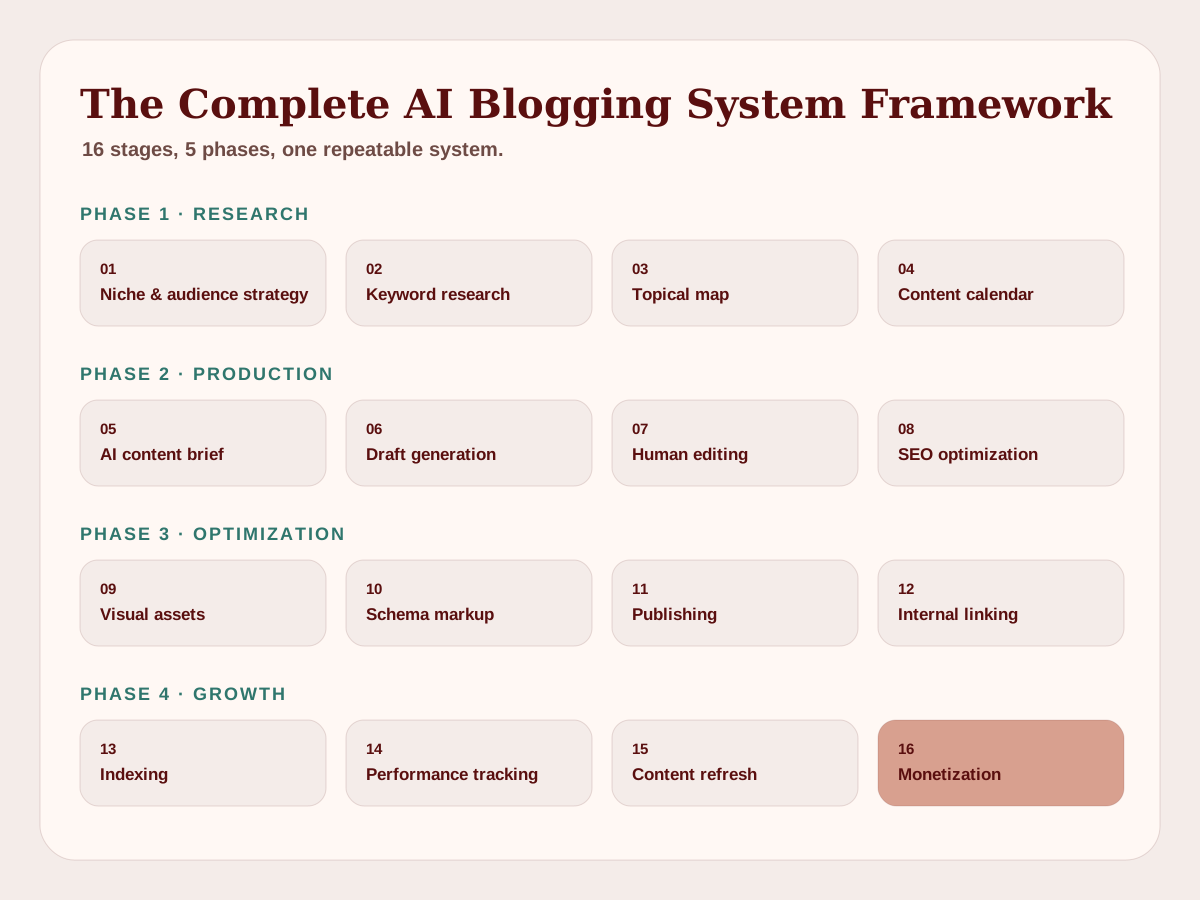
Phase 1 — Research
- Niche and audience strategy
- Keyword research
- Topical map creation
- Content calendar planning
Phase 2 — Production
- AI content brief generation
- Draft generation
- Human editing
- SEO optimization
Phase 3 — Optimization
- Visual asset creation
- Schema markup
- Publishing
- Internal linking
Phase 4 — Growth
- Indexing
- Performance tracking
- Content refreshing
- Monetization
The phases matter. Skipping research forces editing to fix strategy. Skipping editing forces refresh to fix quality. The system keeps each cost where it belongs.
Best AI Blogging Workflow for 2026
Here is the practical, end-to-end workflow.
Step 1 — Define a narrow niche and audience
Before any AI tool runs, decide:
- Who is the reader?
- What outcome do they want?
- What problem are you the right voice for?
A focused niche makes every later step easier — keyword choices, examples, internal links, monetization fit.
Step 2 — Run AI-assisted keyword research
Use AI alongside a keyword tool to find:
- A primary head term per pillar
- 8–20 supporting long-tails per pillar
- Common reader questions (PAA-style)
- Comparison and "best" intents
- Refresh-worthy keywords already in your index
AI accelerates clustering and intent labeling. It does not replace volume and difficulty data from a real tool.
Step 3 — Build a topical map
Group keywords into clusters: one pillar post, several supporting posts, several supporting resources. The topical map becomes the internal linking blueprint.
Step 4 — Plan a realistic content calendar
For most solo or small-team operators, three to five high-quality posts per month beats fifteen mediocre ones. Plan in batches of four weeks.
Step 5 — Generate the AI content brief
Before drafting, generate a detailed brief that includes:
- Target keyword and search intent
- Audience and reading level
- Proposed H2/H3 outline
- Required examples and proof points
- Internal links to add
- Schema and FAQ targets
- Word count range
- CTA and monetization angle
This is the most underused step in AI blogging. A strong brief eliminates 80% of editing later.
For a dedicated four-part framework that covers intent mapping, structure selection, section briefs, and H3 logic — the AI blog post outlining system goes deep on this step specifically.
Step 6 — Generate the draft
Use the brief as the prompt. Generate one section at a time, not the entire article in one shot. Section-level drafting:
- Reduces hallucinations
- Improves coherence
- Lets you steer tone per section
- Makes editing tractable
Step 7 — Human editing pass
This is non-negotiable. Edit for:
- Accuracy and fact-checking
- Original examples and opinions
- Tone and brand voice
- Removing fluff and repetition
- Formatting and scannability
- Internal links and CTAs
For a full five-step framework covering exactly how to strip generic phrasing, add specifics, inject POV, and verify claims, see how to humanize AI content for SEO.
Step 8 — On-page SEO optimization
Apply the on-page checklist (below) before publishing.
Step 9 — Visual assets
Add at least one custom visual: thumbnail, infographic, comparison table, or workflow diagram. Custom visuals signal experience and improve engagement.
Step 10 — Schema markup
Add BlogPosting, FAQPage, and BreadcrumbList schema. Many CMS templates handle this automatically; verify with a structured-data testing tool.
Step 11 — Publish
Publish with a clean URL slug, descriptive meta, optimized image, and matching internal links.
Step 12 — Index and distribute
Submit the URL, link from other relevant posts, and distribute to channels you actually use (Pinterest, newsletter, communities). Don't pretend you'll post on every channel — pick one you can sustain. For Pinterest specifically, see the Pinterest Traffic Engine for AI Creators for the full research-to-monetization workflow.
Step 13 — Track performance
After 60–90 days, review impressions, average position, CTR, and assisted conversions. Don't refresh blindly — refresh where data shows opportunity.
Step 14 — Refresh
Refresh on a 60–120 day cadence, or sooner if intent shifts. Update intro, examples, dates, internal links, and weak sections.
Step 15 — Monetize
Map each post to one primary monetization angle: ad-friendly informational, affiliate intent, product/ebook upsell, lead magnet, or service inquiry.
Recommended AI blogging tool stack (2026)
| Layer | Job | Notes |
|---|---|---|
| AI assistant | Briefs, drafts, edits | Pick one general assistant and learn it well |
| Keyword tool | Volume, difficulty, SERP data | Don't trust AI volume estimates alone |
| CMS / static site | Publishing and schema | Choose for speed and clean markup |
| Design tool | Thumbnails and infographics | Reusable templates beat one-off designs |
| Analytics | Search Console + analytics | Search Console drives most refresh decisions |
| Email + product layer | Monetization | Where attention becomes revenue |
Tools change. Categories don't. Build the workflow first, then plug tools in.
If you are still picking your stack, start with the best AI tools for beginners to anchor the writing and planning layer.
AI keyword research process
A 2026 AI keyword workflow looks like this:
- Seed five to ten core topics from your niche.
- Use a keyword tool to expand into queries with real volume.
- Use AI to label intent: informational, navigational, transactional, comparison.
- Use AI to cluster queries into pillar + cluster groups.
- Score each cluster by business value, not just volume.
- Lock in the next 30–60 days of targets.
Volume without intent is noise. Intent without volume is invisible. You want both.
AI content brief process
A strong brief contains, at minimum:
- Primary keyword + variants
- Search intent and the "promise" the article must keep
- Target audience and tone
- Outline (H2 / H3) with notes per section
- Internal link targets
- External source guidelines
- Required visuals
- Schema targets
- CTA + monetization mapping
Treat the brief as the contract. Drafts that don't match the brief get rejected, not edited.
AI article generation process
Section-level drafting beats one-shot drafting. A reliable pattern:
- Generate the introduction and quick-answer paragraph.
- Generate each H2 section separately, passing the brief context.
- Generate the FAQ block from the question list.
- Generate the conclusion and CTA.
- Stitch and re-read end to end.
This produces drafts that are easier to edit, more on-brief, and less repetitive.
Human-in-the-Loop Editing: Why It Still Matters
AI drafts can ship the structure. They cannot ship judgment. The human editor still owns:
- Accuracy — verifying claims, numbers, names, and dates
- Tone — matching brand voice and audience expectations
- Originality — adding examples, opinions, and proof
- Brand voice — keeping language consistent across posts
- Examples — replacing generic illustrations with real ones
- Formatting — fixing headings, lists, and scannability
- User experience — sentence rhythm, paragraph length, transitions
- Conversion quality — CTAs that match the post's intent
- Factual reliability — removing anything you can't defend
This is also where E-E-A-T shows up. A reader can feel an unedited AI draft within two paragraphs. So can a search-quality system trained to detect it.
If you work with prompts often, the AI prompt workflow checklist gives a reusable structure for getting cleaner first drafts.
SEO optimization checklist
On-page items every post must hit:
- Primary keyword in title, H1, intro, and one H2
- Meta title under 60 characters, meta description under 160
- Clean, lowercase, hyphenated URL slug
- One H1, hierarchical H2/H3
- Descriptive image alt text on every image
- Featured image with optimized dimensions and format
- Internal links to relevant pillar and cluster posts
- External links only to credible sources
- FAQ section with question-based H3s
- Schema markup validated
- Mobile-friendly layout
- Reasonable Core Web Vitals
- A clear CTA above and below the fold
Treat the checklist as a release gate. No item, no publish.
Internal linking strategy
Internal links are how topical authority compounds.
- Every pillar post links down to at least 4–8 supporting posts.
- Every supporting post links up to its pillar and sideways to 1–2 siblings.
- Anchor text is descriptive and varied — never just "click here."
- Resources, tools, and product pages get linked from relevant clusters.
- Audit links every quarter and after every refresh.
A pillar post that doesn't link out is a dead end. A cluster post that doesn't link up is an orphan.
Schema markup strategy
For an AI blog, ship at minimum:
- BlogPosting — for every article
- FAQPage — when the post has a real FAQ section
- BreadcrumbList — for navigation context
- HowTo — when the post is genuinely a step-by-step process
- Organization + Person — site-wide
Validate after publishing. Schema errors silently cap how rich your snippets can become.
Visual content workflow
For each pillar post, plan:
- 1 featured thumbnail (1200×675, on-brand)
- 1–3 inline diagrams or comparison visuals
- Optional: 1 vertical Pinterest pin
Reuse a small visual library — same palette, fonts, spacing, and layout grid. Custom visuals beat stock images in both engagement and SEO signals.
Publishing workflow
A clean publish loop:
- Final read-through on a real device, not just the editor.
- Pre-flight SEO checklist.
- Schedule or publish.
- Submit URL for indexing.
- Add to internal link map (update older posts that should link in).
- Distribute to one or two channels you can sustain.
- Tag for the next refresh date.
Content updating and refresh system
Most AI blogs lose ranking not from quality but from neglect.
A repeatable refresh:
- Pull posts ranked positions 5–20 with declining trends.
- Recheck SERPs and intent.
- Update intro, examples, dates, statistics, and screenshots.
- Add new internal links.
- Improve or replace weak sections.
- Republish with an updated date and re-index.
A simple operating cadence: refresh top 10 revenue or traffic posts every 60–90 days; refresh the rest every 6 months.
Analytics and performance tracking
Track only what changes decisions:
- Impressions and clicks (Search Console)
- Average position by query
- CTR vs. position benchmarks
- Top landing pages and assisted conversions
- Email signups and product clicks per post
If a metric never changes a decision, stop tracking it.
Monetization strategy
Map each post to one primary monetization angle:
- Ad-friendly informational pillars
- Affiliate-led "best of" and comparison posts
- Product / ebook upsell from how-to guides
- Lead magnet on resource-led posts
- Service inquiry from pillar consulting topics
The simplest first product is usually a focused ebook tied to your strongest pillar. If you want to see this pattern end to end, the First $100 With AI ebook walks through one packaged execution path from idea to first sale.
For a longer view of how blogging fits into broader AI income systems and AI execution systems, follow those pillars next.
Common mistakes to avoid
- Publishing one-shot AI drafts without editing
- Targeting keywords without checking real intent
- Writing dozens of thin posts instead of fewer strong ones
- Skipping internal linking and schema
- Refreshing on vibes instead of data
- Adding too many tools too early
- Treating AI as the writer instead of the assistant
- Monetizing before the topic actually has traffic
Most failed AI blogs fail on these eight, not on tools.
Example AI blogging workflow (one post, end-to-end)
Day 1 — Research and brief
- Pick keyword: "AI content workflow for beginners"
- Confirm intent: informational, beginner audience
- AI clusters supporting questions
- Generate full brief
Day 2 — Draft
- Section-by-section AI drafting
- Save to CMS or doc
Day 3 — Edit, optimize, visualize
- Human edit pass (accuracy, examples, tone)
- On-page SEO checklist
- Custom thumbnail + 1 inline diagram
- Schema and internal links
Day 4 — Publish and distribute
- Publish, submit for indexing
- Update 2–3 older posts to link in
- Distribute to Pinterest + newsletter
Day 60 — Review
- Check Search Console
- Refresh if needed
This is roughly the flow used in the AI content workflow for beginners guide and the beginner AI workflows guide.
AI Blogging System Checklist
Copy and use this for every post:
- Niche and audience confirmed
- Primary keyword + 5–10 long-tails identified
- Search intent labeled
- Cluster + pillar relationship defined
- Brief written and approved
- Section-level draft generated
- Human edit pass complete
- On-page SEO checklist passed
- Custom thumbnail created
- At least one inline visual added
- FAQ written with real questions
- BlogPosting, FAQPage, BreadcrumbList schema present
- Internal links in (4–8) and out (2–4)
- External links credible only
- CTA mapped to monetization angle
- Mobile preview reviewed
- Submitted for indexing
- Refresh date scheduled
If a post can't tick every box, it isn't ready.
FAQ: The Ultimate AI Blogging System
What is an AI blogging system?
An AI blogging system is a repeatable workflow that uses AI for keyword research, briefs, drafts, optimization, and refresh, with humans in control of strategy, accuracy, examples, and quality.
Can AI write SEO blog posts?
AI can draft SEO blog posts, but ranking content still needs intent matching, original examples, fact-checking, internal links, schema, and a human edit pass before publishing.
Is AI blogging still effective in 2026?
AI blogging is effective in 2026 when it is used inside a system that prioritizes topical authority, original value, human review, and helpful-content signals over volume.
What tools do I need for AI blogging?
A practical AI blogging stack includes one general AI assistant, a keyword tool, a document or CMS, a design tool, an analytics tool, and a publishing channel.
How do I make AI-generated blog content rank?
Make AI content rank by matching search intent, building topical clusters, adding original examples, optimizing on-page SEO, using schema markup, earning internal links, and refreshing regularly.
Should AI blog posts be edited by humans?
Yes. AI drafts should always pass a human edit for accuracy, tone, originality, examples, formatting, internal links, conversion quality, and brand voice before publishing.
How often should I update AI-generated blog posts?
Refresh high-priority AI blog posts every 60 to 120 days, or sooner if rankings drop, intent changes, the topic moves quickly, or the post drives revenue.
Can AI blogging make money?
AI blogging can make money through ads, affiliate links, digital products, services, or email lists, but only when the content is genuinely useful and the monetization fits reader intent.
Next step
The Ultimate AI Blogging System (2026 Edition) only works if you actually run it on one post. Pick one keyword, run the full 16-stage workflow once, then turn the result into your template.
If you are new to blogging with AI and want a simpler entry point before tackling the full 16-stage system, the AI blogging workflow for beginners distills the process into 7 repeatable execution steps — a practical first run before you scale.
To keep the system running at scale, you need a planning layer above the workflow. The AI content calendar for niche sites covers keyword clustering, publish sequencing, and the 90-minute monthly planning session that turns a list of post ideas into a coordinated publishing schedule.
For the SEO optimization stage specifically — where Yoast meta titles and descriptions get written — see the guide to automating Yoast SEO meta with AI. It covers the prompt templates, bulk workflow, and 30-second edit checklist that make Phase 4 of this system repeatable.
The workflow system extends beyond blog content. For clinics and healthcare practices, the same structured-prompt approach powers patient communication — the clinic email templates guide shows copy-paste prompts for appointment reminders, follow-ups, and reactivation emails built on the same principles.
If you want a packaged execution path that pairs with this system — niche, offer, content, and first sale — read the First $100 With AI ebook. It is the fastest way to apply the same workflow to a real, monetized outcome.
Related AI systems
Continue with connected AI workflow guides.
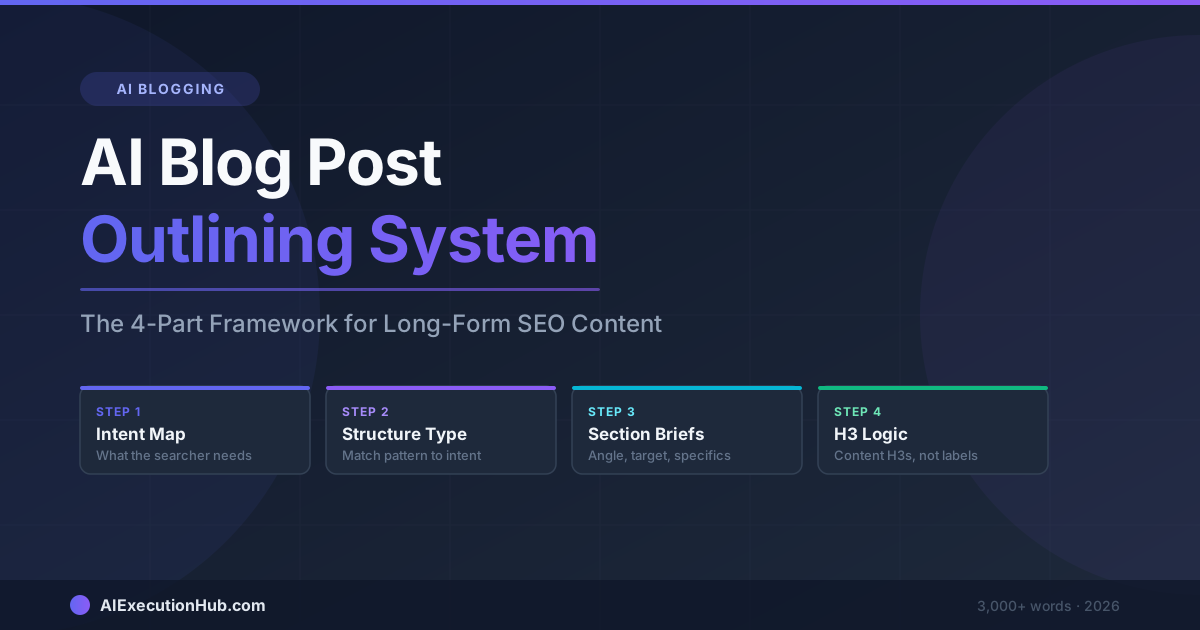
AI Blog Post Outlining System: The 4-Part Framework for Long-Form SEO Content
A practical AI blog post outlining system that structures long-form SEO content before drafting — 4 steps from keyword intent to section briefs that write themselves.
Claude vs ChatGPT for SEO Blogging: A Task-by-Task Verdict
Claude vs ChatGPT for SEO blogging — a task-by-task breakdown of which AI wins for outlines, meta descriptions, tone editing, internal linking, and more.
AI Content Calendar for Niche Sites: A Practical Planning System
Build an AI content calendar for your niche site — keyword clustering, publishing cadence, seasonal timing, and a repeatable monthly planning system.