AI Blogging
How to Humanize AI Content for SEO
Learn how to humanize AI content for SEO with a practical editing workflow that satisfies Google's helpful content signal — no bypass tools needed.
Most creators using AI to write content make the same mistake. They treat the AI draft as the final product — and then wonder why it does not rank or why readers bounce.
The problem is not that AI wrote the post. The problem is that nobody edited it.
Humanizing AI content for SEO is not about tricking a detection tool. It is about editorial judgment: taking a technically correct but generic draft and turning it into something a real person with real experience would have written. That is what Google's helpful content signal actually rewards.
This guide covers a practical editing workflow you can apply to any AI draft, without a bypass tool, in under two hours.
What does it mean to humanize AI content for SEO?
Humanizing AI content for SEO means editing a machine-generated draft until it reads like it was written by someone with genuine experience on the topic — specific examples, a clear point of view, accurate claims, and natural sentence rhythm. It is an editorial process, not a technical one. The goal is not to hide that AI was involved. The goal is to ensure the content is genuinely useful to the reader, which is what search engines reward.
Why AI content fails Google's helpful content signal
Google's helpful content system evaluates whether content exists primarily to help a reader or primarily to rank. AI drafts, as generated, tend to fail on a specific set of signals.
Generic structure. AI defaults to whatever pattern appeared most often in its training data. For most informational posts, that means a padded intro, three to five H2s with interchangeable advice, and a conclusion that summarizes what was just said. No distinctive perspective, no real system, nothing a reader could not get from a dozen other sites.
Averaged phrasing. AI produces text that sounds plausible because it reflects the average of what many humans have written. That average tone — technically correct but personality-free — is what most people recognize as "AI-written."
Vague claims. "AI can help you save time" appears in thousands of AI-written posts with no specifics attached. Which tasks? By how much? Compared to what alternative? Vagueness signals to both readers and ranking systems that the content is not grounded in actual experience.
Invented or unverifiable specifics. Some AI models fill detail gaps with plausible-sounding numbers or attributions that do not hold up to fact-checking. A single invented statistic undermines the entire post's credibility.
Padding. AI drafts frequently restate the intro at the end, repeat points across sections, and add transitional paragraphs that exist only to increase word count.
None of these are unfixable. They are all editorial problems with editorial solutions.
The 5-step humanization editing framework
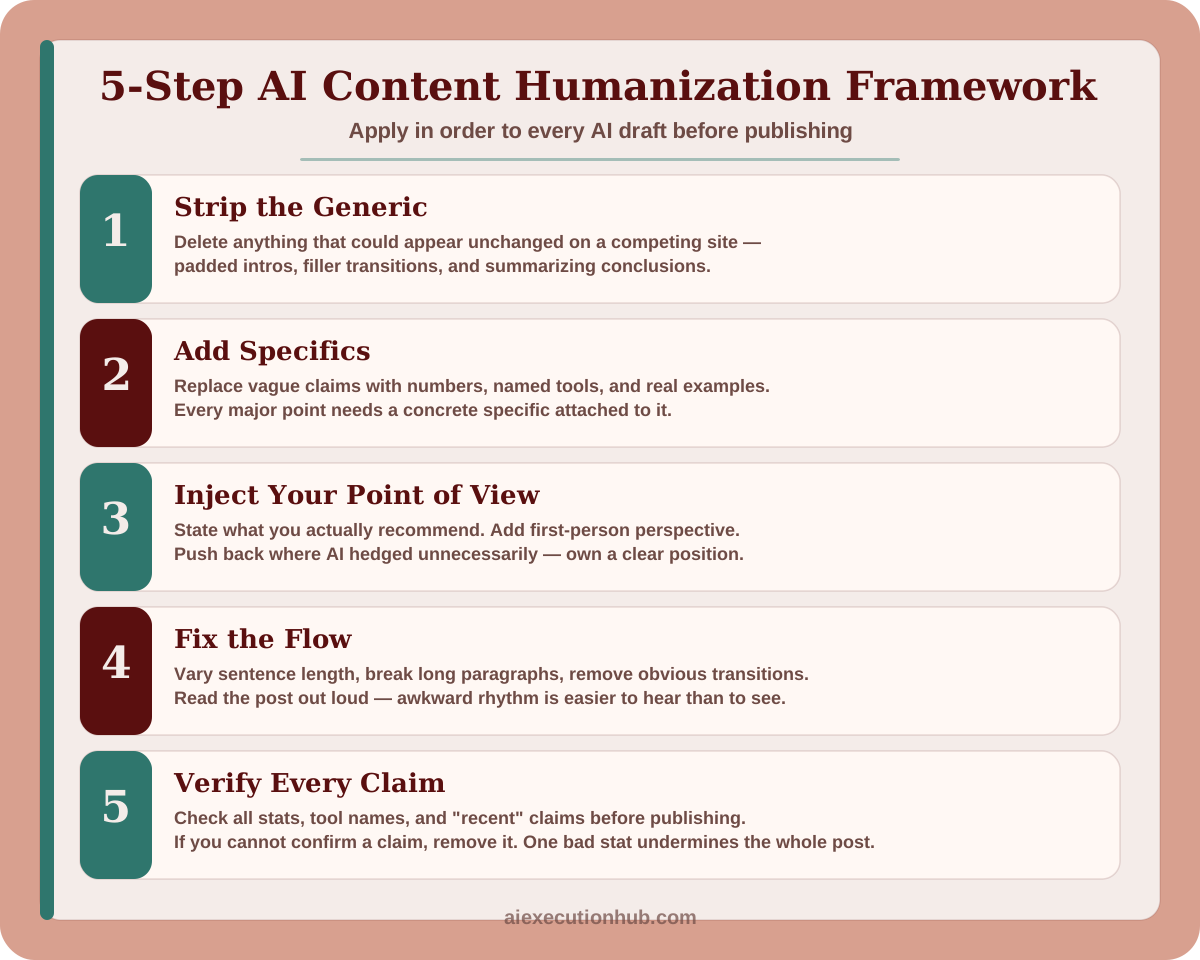
Apply these five steps in order to every AI draft before publishing.
Step 1: Strip the generic
Read the draft from top to bottom and delete anything that could appear on any website covering this topic without being wrong. If a paragraph would be equally true for a post on a competing site, it adds no value on yours.
Common patterns to cut:
- Opening sentences that restate the topic without adding information ("In today's digital landscape, AI content is everywhere")
- Transition paragraphs that do nothing except connect two sections that did not need connecting
- Conclusions that summarize the article you just read
- Bullet lists where every item is a one-sentence platitude
Delete first, rewrite after. Most AI drafts lose 15–20% of their word count in this step and improve immediately.
Step 2: Add specifics
Replace every vague claim with a specific, concrete version.
| Generic (remove) | Specific (replace with) |
|---|---|
| "AI can speed up your workflow" | "AI drafting a 1,500-word section takes about 8 minutes — the same section takes most writers 45 minutes" |
| "Many bloggers use AI tools" | "ChatGPT, Claude, and Gemini are the three tools most creators mention when discussing AI drafting workflows" |
| "This process saves time" | "The outline-first approach reduces total drafting time from 90 minutes to about 40 for a 2,000-word post" |
Every major claim in the post should have a specific attached to it — a number, a named tool, a concrete workflow step, or a real example. If you cannot make a vague claim specific without inventing data, remove the claim.
Step 3: Inject your point of view
AI drafts are deliberately neutral. They present balanced perspectives and hedged conclusions because that is the safe output given training data from many different viewpoints.
Your posts should not be neutral on questions where you have a clear position.
This means:
- Stating what you actually recommend, not listing three options and saying "it depends"
- Adding a sentence or two that reflects genuine experience ("In practice, the section-by-section prompting approach works better than one-shot drafting for posts over 1,200 words — the one-shot version always needs more editing time than just drafting section by section")
- Pushing back where the AI has hedged unnecessarily ("You do not need a paid keyword tool to start — Google autocomplete is genuinely sufficient for a beginner's first 20 posts")
A real point of view differentiates your content from every other post on the same keyword. It is also a direct E-E-A-T signal.
Step 4: Fix the flow
AI rhythm is predictable: medium-length sentences with similar structure, grouped into paragraphs of roughly equal size. Reading a full post in this cadence is exhausting.
Fix flow by:
- Varying sentence length. Short sentences land harder. Longer sentences carry more nuance and context, but they need a short sentence nearby to give the reader a breath.
- Breaking up long paragraphs. Three to four lines is a reasonable ceiling for a web paragraph. If a paragraph runs longer, look for a natural split.
- Removing transitions that state the obvious ("Now that we have covered X, let us move on to Y")
- Reading the post out loud. Awkward rhythm is easier to hear than to see on screen.
You are not rewriting the article. You are adjusting the pacing so it reads like a person wrote it.
Step 5: Verify every factual claim
Before publishing, verify:
- Any statistic or percentage — if you cannot trace it to an original source, remove it
- Any named tool, product, or platform — confirm it exists and does what the draft claims
- Any "recent" or dated claim — AI training data has a cutoff; confirm currency before publishing
- Any process or workflow step that involves a specific platform (interface descriptions go stale quickly)
One unverified statistic that a reader can fact-check and disprove destroys trust in the whole post. The standard is simple: only publish claims you can stand behind.
The editing checklist
Copy this before every AI-drafted post goes live:
Strip generic
- Intro does not open with a restatement of the topic
- No paragraphs that exist only to connect other sections
- No conclusion that just summarizes the article
- Removed at least one section or paragraph that added no new information
Add specifics
- Every major claim has a concrete example, number, or named tool attached
- No vague statements left unsupported ("AI saves time", "many bloggers use this")
- At least one real, specific scenario that illustrates the main point
Inject POV
- At least two places where the post takes a clear position rather than hedging
- First-person perspective present in at least one section
- Author's recommended approach is stated clearly, not hidden behind "it depends"
Fix flow
- Sentence length varies within each section
- No paragraph longer than 4–5 lines
- Post reads cleanly out loud with no stumble points
Verify claims
- All statistics and percentages checked or removed
- All named tools and platforms confirmed to exist and be accurately described
- No "recent" claims that rely on potentially outdated AI training data
Common humanization mistakes
Using an AI bypass tool instead of editing. Tools that rewrite AI output to evade detection are solving the wrong problem. They change the surface-level phrasing but leave the structural problems — generic claims, no POV, padded sections — intact. The post still fails the helpfulness test. Edit the content, not the detection score.
Editing for voice without editing for accuracy. Adding personal anecdotes and varying sentence length does not fix invented statistics or outdated tool descriptions. Both passes are required.
Preserving the AI intro. AI-generated introductions almost always open with a generic context-setting statement. Delete the first one to three sentences of any AI draft and rewrite the opening directly — most posts improve immediately.
Treating word count as quality. A humanization pass that adds examples and removes padding will often reduce word count. That is correct. A shorter, specific, accurate post outperforms a longer, padded one on every signal that matters.
One-pass editing. Read once for structure (cut and rearrange), then once for specifics (add examples and verify facts), then once for flow (sentence rhythm and phrasing). Trying to do all three in a single pass means each gets less attention than it needs.
Example: humanizing a real AI draft
Here is what the before/after of a single paragraph looks like in practice.
Before (raw AI output):
"AI content creation has become increasingly popular among bloggers and content creators. Many people are using AI tools to speed up their workflow and produce more content in less time. However, it is important to ensure that AI-generated content meets the quality standards required for SEO success."
This paragraph is three sentences long and contains zero information a reader does not already know from having read the title of the post.
After (humanized):
"Most AI drafts are structurally correct and factually approximate — they hit the right topics in roughly the right order, and nothing in them is obviously wrong. That is the problem. Content that is not wrong is not the same as content that is useful. The editing pass is where a draft becomes a post worth reading."
The revised version takes a position, uses specific language, and says something the reader cannot get from the title alone.
Apply this test to every paragraph: does this tell the reader something they would not already assume from knowing the topic exists?
FAQ: how to humanize AI content for SEO
Does Google penalize AI-written content?
Google does not penalize content for being AI-written. It penalizes content that is unhelpful, thin, or lacks original insight — regardless of how it was produced. AI content that has been edited for accuracy, specificity, and genuine usefulness can rank well.
How do you humanize AI content for SEO?
Humanizing AI content for SEO means editing the draft to remove generic phrasing, add specific examples and personal perspective, fix factual claims, vary sentence rhythm, and ensure every section answers a real question a reader would actually ask.
What makes AI content fail Google's helpful content update?
AI content fails Google's helpful content signal when it is written primarily to rank rather than to help — thin answers, padded word counts, no original perspective, invented statistics, and content that could apply to any site in any niche.
Do I need a tool to humanize AI text?
No. Bypass tools that claim to rewrite AI output to evade detection address the symptom, not the cause. The correct approach is editorial — editing the draft so it contains genuine specificity, accurate claims, and a clear human perspective.
How long does it take to humanize an AI blog post?
A 1,500–2,500 word AI draft typically takes 45–90 minutes to humanize through a full editorial pass — removing padding, adding examples, verifying facts, and adjusting tone. Rushed editing produces content that still reads as generic.
What is the difference between AI content and humanized AI content?
Raw AI content defaults to generic structure, vague claims, and averaged phrasing pulled from training data. Humanized AI content has been edited to include specific examples, a clear point of view, verified facts, and natural sentence rhythm that reflects a real author's voice.
Can humanized AI content rank on Google?
Yes. Humanized AI content that is genuinely helpful, specific, and accurate can rank the same as content written entirely by a human. The ranking signal is usefulness, not production method.
How do I add E-E-A-T to AI-generated blog posts?
Add E-E-A-T to AI blog posts by including first-person experience or opinion, citing specific real-world examples, attributing claims to verifiable sources, using a consistent author byline, and writing with a clear point of view rather than balanced neutrality on every question.
Next steps
The five-step framework in this guide covers the editorial side of humanizing AI content. The upstream piece — how to prompt AI so the draft requires less editing in the first place — is what a structured AI blogging workflow for beginners addresses. Running both together means faster drafts and less editing time per post.
For the full production system that connects keyword research, drafting, editing, SEO, and publishing into one repeatable pipeline, the Ultimate AI Blogging System (2026 Edition) covers every stage in detail.
If you want to take the content you are producing and connect it to a practical first income system, the First $100 With AI ebook maps the path from consistent AI-assisted content to your first real online sale — including the exact monetization steps most beginner guides skip.
Related AI systems
Continue with connected AI workflow guides.
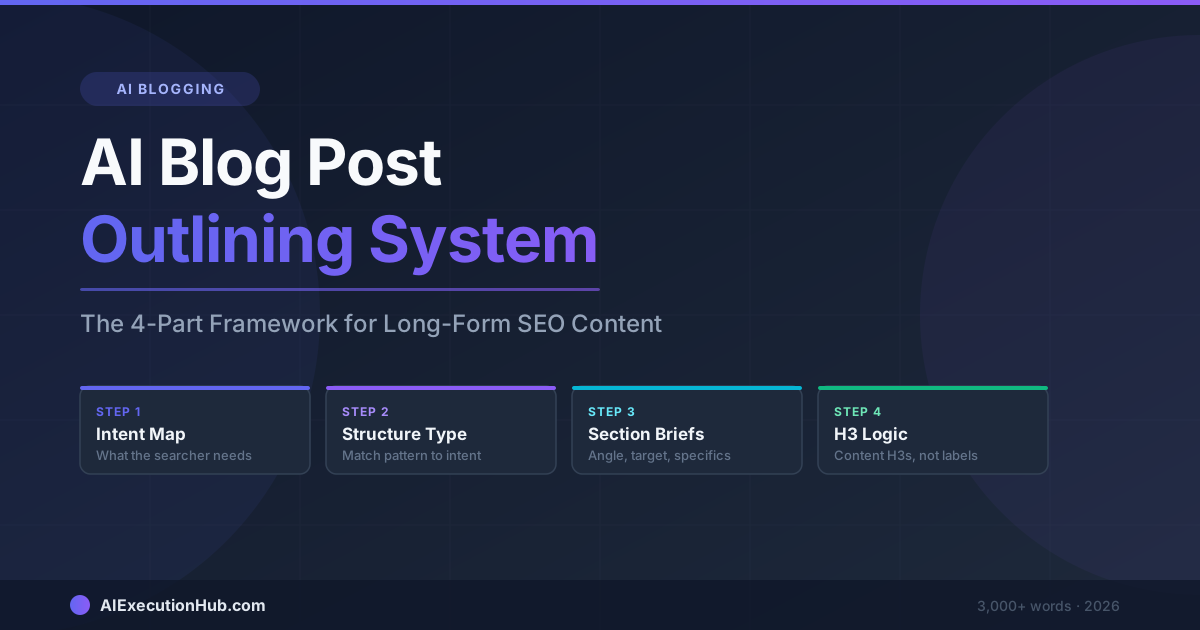
AI Blog Post Outlining System: The 4-Part Framework for Long-Form SEO Content
A practical AI blog post outlining system that structures long-form SEO content before drafting — 4 steps from keyword intent to section briefs that write themselves.
Claude vs ChatGPT for SEO Blogging: A Task-by-Task Verdict
Claude vs ChatGPT for SEO blogging — a task-by-task breakdown of which AI wins for outlines, meta descriptions, tone editing, internal linking, and more.
AI Content Calendar for Niche Sites: A Practical Planning System
Build an AI content calendar for your niche site — keyword clustering, publishing cadence, seasonal timing, and a repeatable monthly planning system.