AI Side Hustles
AI Flashcard Side Hustle: How to Create and Sell Study Decks
A practical guide to building an AI flashcard side hustle — create, package, and sell study decks on Etsy, Gumroad, and Anki marketplaces using a repeatable AI workflow.
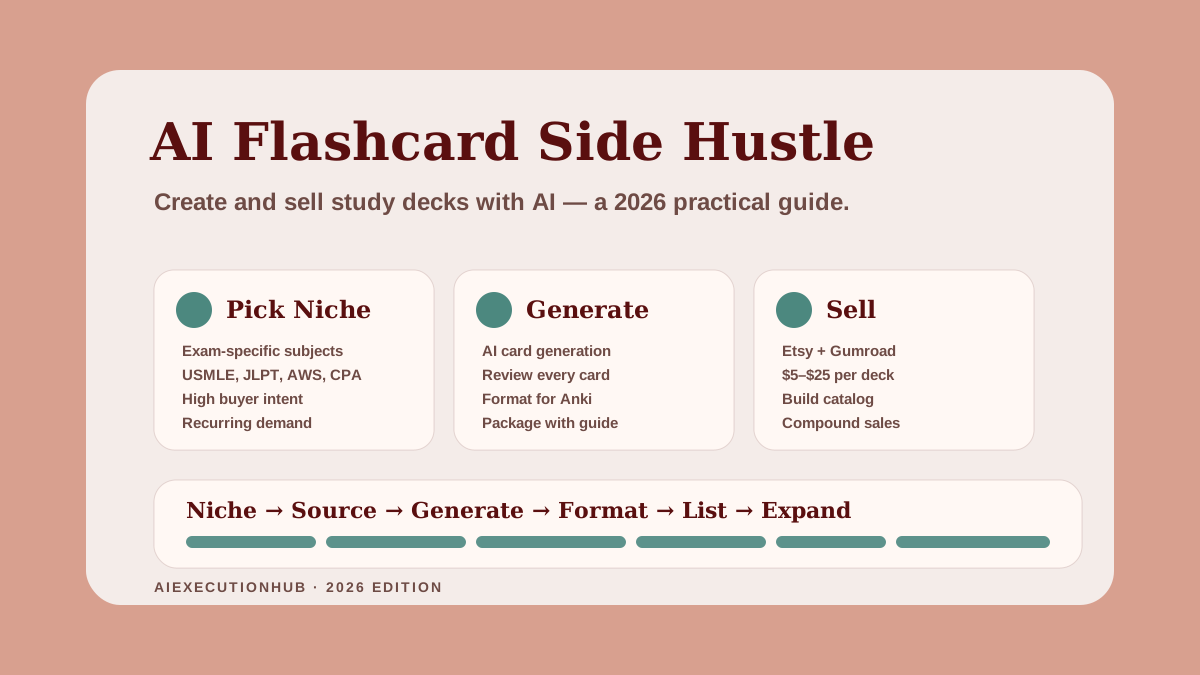
An AI flashcard side hustle works for a simple reason: students need study materials constantly, the market is large and recurring, and a well-built deck costs almost nothing to produce once you have the workflow.
The problem is that most people who try it build the wrong thing. They generate a broad "biology flashcards" deck, upload it to Etsy, and wonder why nothing sells. The decks that sell are narrow — a specific exam, a specific course level, a specific language certification. The AI creates the volume. Your judgment picks the target.
This guide is a complete system for the AI flashcard side hustle: how to pick a subject, how to build the deck, how to format it for the platforms that pay, and how to run the workflow so your second deck takes half the time of your first.
Can you make money with an AI flashcard side hustle?
Yes. AI-assisted study decks sell consistently on Etsy, Gumroad, and Teachers Pay Teachers when they target a specific exam or course. A well-chosen deck priced at $5–$15 can earn $50–$300 per month per product once it has reviews and search visibility. The model works because the build cost is low, the product is digital, and buyer demand for study materials is stable year-round.
The caveat is specificity. Generic decks — "chemistry flashcards," "history facts" — face too much free competition from Quizlet public decks and open educational resources. Exam-specific decks ("USMLE Step 1 renal physiology deck," "JLPT N3 kanji with mnemonics") serve buyers who are searching with high intent and willing to pay for organized, reliable material.
Why the flashcard market is a practical AI side hustle in 2026
Flashcard demand is structural, not trend-driven. Students in medicine, law, language learning, and professional certification have been buying study materials for decades. AI changes the build side, not the demand side.
Three things make this a good fit for a beginner AI side hustle:
No fulfillment overhead. A digital file is uploaded once and delivered automatically. You do not manage inventory, shipping, or returns.
Recurring buyer pools. Exam seasons repeat every year. A USMLE or bar prep deck that ranks in Etsy search in June will sell again in June next year with no additional effort.
Compound catalog effect. Each new deck you add to a focused catalog reinforces the others. A buyer who purchases your JLPT N4 grammar deck will come back for your JLPT N3 deck. A general freelance service does not compound this way.
The realistic constraint is that the first deck takes the most time: learning the workflow, understanding the format, writing a good listing. The second deck takes about half as long. By the fifth, the AI workflow is nearly automatic.
The AI flashcard side hustle framework: 6 stages
A reliable AI flashcard business is not one deck made once. It is a six-stage cycle that repeats.
Stage 1 — Niche selection. Choose a subject with clear buyer intent, low free competition, and a defined buyer pool. Exam prep and certification subjects are the strongest starting categories.
Stage 2 — Source gathering. Collect the source material for your deck: official syllabuses, past paper question formats, textbook chapter lists, vocabulary lists, or learning objectives. AI generates better output from structured source content than from open-ended prompts.
Stage 3 — AI generation. Use your AI assistant to produce question-and-answer pairs in batches from the source material. Review every card. Remove weak output. Add context where the AI produced a bare answer.
Stage 4 — Formatting and packaging. Convert the deck into the file format the platform accepts (.apkg for Anki, tab-separated text for Quizlet import, PDF for Etsy). Write a short setup guide. Design a cover image.
Stage 5 — Listing and pricing. Write a clear product listing with the exam name, card count, and what the buyer can do with the deck. Price between $5–$20 depending on card count and specificity.
Stage 6 — Catalog expansion. Add related decks in the same subject area. Cross-link them in your listings. Review buyer feedback and revise the weakest cards in existing decks once a quarter.
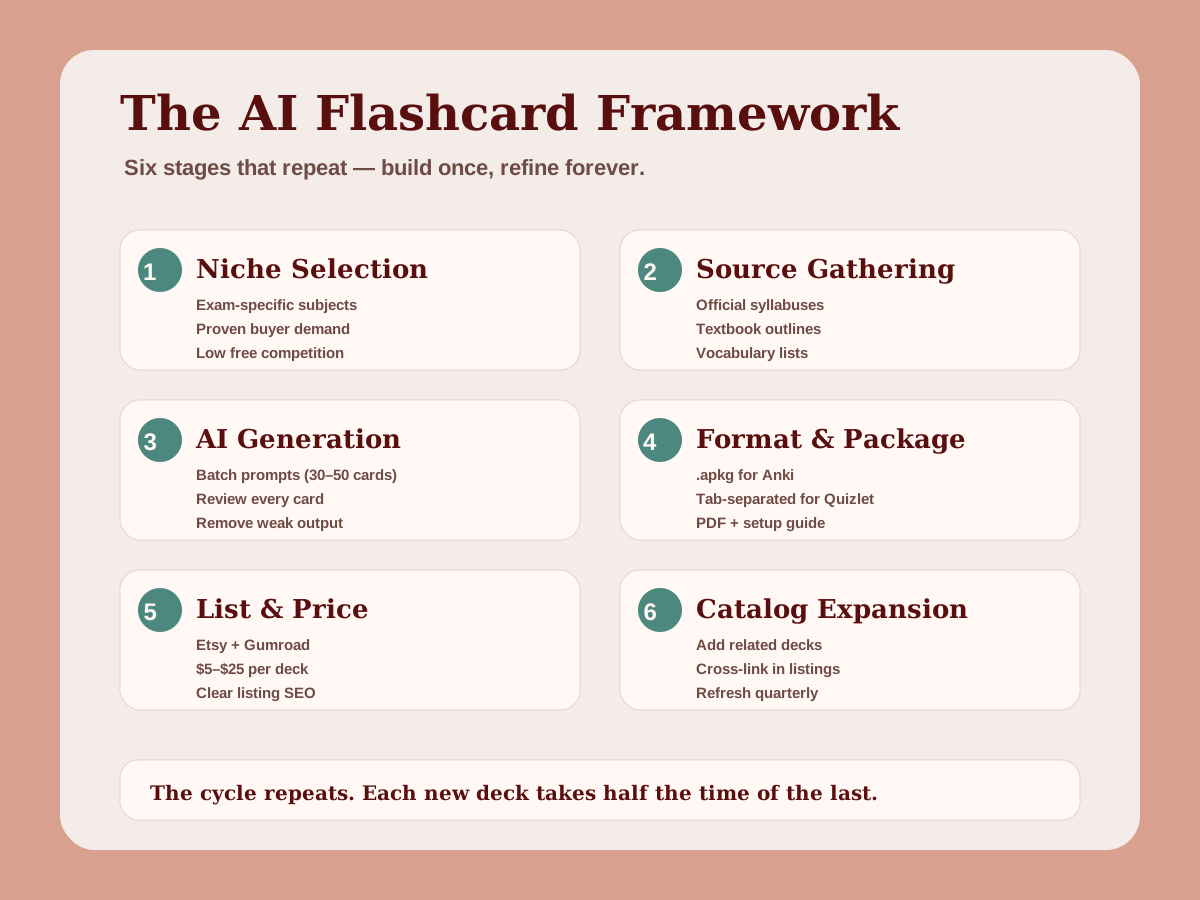
The six-stage cycle for building a repeatable AI flashcard business. Each new deck takes half the time of the last.
Step-by-step workflow: build your first deck in one weekend
This workflow is designed to produce a sellable product end-to-end. Days are guidelines, not deadlines.
Step 1 — Pick the niche (30 minutes)
Search Etsy for flashcard decks in the subject you are considering. Look at:
- How many results exist?
- What are the top-selling decks about specifically?
- Are buyers leaving reviews that mention what they wished the deck included?
- Is there a sub-topic inside the subject that has fewer results than the subject itself?
The ideal target is a subject with proven buyers (existing sales and reviews) but a sub-topic gap (few decks at that specific level or angle).
Strong starting categories:
| Subject area | Specific angle example |
|---|---|
| Medical licensing | USMLE Step 1 — organ-specific physiology |
| Language learning | JLPT N4 vocabulary with kanji + furigana |
| Professional certs | AWS Solutions Architect — service definitions |
| Law bar prep | MBE constitutional law key holdings |
| AP / A-level science | AP Biology — cell signaling pathways |
| CPA exam | FAR section — financial statement presentation |
Pick one. A specific angle in a proven subject beats a broad topic in an untested one.
Step 2 — Gather source material (1–2 hours)
Collect the input your AI will work from. Good sources:
- Official exam syllabuses and learning objective lists (publicly available for most major certifications)
- Textbook chapter outlines and summary sections
- Vocabulary lists from official language learning bodies
- Publicly available past-paper question formats (not the questions themselves)
Organize the source content into a plain-text or markdown file. Group it by topic. The cleaner your input, the better the AI output.
Step 3 — Generate the cards with AI (2–4 hours)
Open your AI assistant. Use this prompt structure as a starting point:
I am building a study flashcard deck for [exam or subject].
Here is the source material:

[paste source content]

Generate 30 question-and-answer flashcard pairs from this material.
Format each as:
Q: [question]
A: [answer, 1–3 sentences, specific enough to study from]

Rules:
- Questions should test recall of a specific fact, definition, or relationship.
- Answers must be correct and complete without being exhaustive.
- Do not repeat the same concept twice.
- Avoid vague questions like "What is important about X?"
Run this prompt in batches of 30–50 cards per topic section. Review each batch immediately. Remove:
- Cards with vague or debatable answers
- Cards that test trivia rather than exam-relevant concepts
- Duplicate cards
- Cards where the AI answer is confidently wrong (verify anything factual)
A 200-card deck typically requires 3–4 prompt batches and 45–90 minutes of review.
Step 4 — Format for your platform (1–2 hours)
For Anki (.apkg):
Export your reviewed Q&A pairs as a tab-separated text file (one per line: question[tab]answer). Import into the Anki desktop app via File → Import. Configure the note type as "Basic." Export the finished deck as .apkg. This is the file you sell.
For Quizlet import (tab-separated text):
The same tab-separated format imports directly into Quizlet via the "Import" function in the set editor. If you are selling a "Quizlet-ready" product, deliver the text file plus a one-page import guide.
For Etsy PDF:
Some buyers prefer a printable or browser-viewable format. Use a free design tool to lay out cards two-per-row across a clean PDF. Include the question on one side of the card, the answer on the back. Export as PDF. This works for buyers who study from paper or tablet.
Step 5 — Write the listing (45–60 minutes)
A strong Etsy or Gumroad listing has:
- Title: Exam name + card count + format. Example: "USMLE Step 1 Renal Physiology Flashcard Deck — 180 Anki Cards (.apkg + PDF)"
- Description opener: What the deck covers, who it is for, and what they will be able to do after using it.
- Card count and format breakdown: Be specific. "180 cards covering glomerular filtration, tubular reabsorption, acid-base regulation, and diuretic mechanisms."
- What is included: .apkg file, PDF version, import guide.
- One sentence on how to use it: "Download the .apkg file, open Anki, and import under File → Import. Ready to study in under two minutes."
Do not over-promise on outcomes. "Covers the renal physiology tested on Step 1" is honest. "Pass your exam with this deck" is not.
Step 6 — Design a cover image (30 minutes)
Your Etsy or Gumroad thumbnail needs to communicate the subject and format at a glance. A clean, text-forward design works better than a complex illustration. Use:
- Subject name in large text
- Card count and format badge
- Brand color or clean neutral background
- No stock photography — it looks generic
A free design tool is enough at this stage. Keep it simple.
Platform comparison: where to sell your flashcard decks
Each platform has a different buyer profile, fee structure, and discovery mechanism. Match your platform to where your buyers already search.
| Platform | Best for | Fee structure | Discovery method | Setup friction |
|---|---|---|---|---|
| Etsy | General study materials, printable PDF decks | 6.5% transaction + $0.20 listing fee | Etsy search + Pinterest saves | Low |
| Gumroad | Anki .apkg files, direct audience sales | 10% flat (free plan) | External traffic required | Very low |
| Teachers Pay Teachers | K–12 and college supplemental materials | 20–45% commission | TPT search engine | Low–Medium |
| Payhip | Digital files, simple checkout | 5% transaction (free plan) | External traffic required | Very low |
| Own website | Catalog building, email list capture | Payment processor fees only | SEO + Pinterest | High upfront |
Recommended starting path: Build on Gumroad first (fastest setup, no listing restrictions on file type). Add an Etsy listing once you have a finished, reviewed product with a clean cover image. Etsy's built-in search traffic is the fastest route to the first organic sale.
Tool stack for the AI flashcard workflow
You do not need a large stack. A beginner can run this entire workflow with three tools.
| Task | Recommended tool | Cost |
|---|---|---|
| AI card generation | ChatGPT, Claude, or Gemini | Free tier sufficient for most batches |
| Anki deck creation | Anki desktop app | Free |
| Cover image | Canva free tier | Free |
| PDF layout | Canva or Google Slides | Free |
| Selling platform | Gumroad free plan | Free (10% per sale) |
| Optional: email list | ConvertKit free tier | Free up to 1,000 subscribers |
Paid tools only make sense once you have confirmed the offer works and a paid feature is the bottleneck. Most creators run at $0 until their first 10–15 sales.
Pricing your flashcard decks
Most new sellers underprice. A 200-card deck built for a specific medical licensing exam took real time to research, prompt, review, and package. Price it accordingly.
Practical pricing benchmarks:
| Deck type | Card count | Price range |
|---|---|---|
| Small topic deck (one chapter or unit) | 50–80 cards | $3–$7 |
| Medium exam-prep deck (one subject area) | 100–200 cards | $8–$15 |
| Comprehensive exam deck (full subject) | 250–500 cards | $15–$25 |
| Bundle (3–5 related decks) | 400–1,000+ cards | $20–$40 |
Price your first deck in the middle of its range. After the first 5–10 reviews, you will have enough signal to know whether the price is a barrier or irrelevant to buyer decisions.
Building a catalog: the compounding model
A single deck is a product. A catalog is a business.
The compounding effect works because buyers in a subject area come back. A student preparing for the JLPT N5 exam who finds your N5 vocabulary deck will search your shop for the N4 deck when they advance. A medical student who uses your Step 1 renal deck may buy your Step 1 cardiac deck next.
A practical catalog-building plan:
- Start with one niche. Do not spread across subjects until you have 3–5 decks in one area with proof of sales.
- Expand depth before breadth. Within your chosen subject, cover more of the same exam or course before moving to a different subject.
- Create bundles. A bundle of three related decks at a slight discount increases average order value and makes the listing feel more complete.
- Refresh once a quarter. Remove cards that buyers flag, add new cards for topic areas they request, and update the listing with a revised card count.
A catalog of 8–12 focused decks in one subject area is more valuable — and more visible in search — than 30 scattered single decks across 15 unrelated topics.
Quality control: what makes a deck actually sellable
This is where most AI-generated flashcard products fail. The cards exist, but they are not actually useful to study from.
Apply this checklist to every deck before publishing:
Card-level checks:
- Does the question test one specific, recall-worthy fact?
- Is the answer correct? (Verify factual claims — AI makes confident errors on exam-specific content.)
- Is the answer complete enough to study from, without being a paragraph?
- Is this card testing something an actual exam would test?
Deck-level checks:
- Does the deck cover the topic systematically, not randomly?
- Are cards organized by topic section, not shuffled at random?
- Is the card count accurately stated in the listing?
- Does the included setup guide explain import in two steps or fewer?
Common AI output problems to fix:
- Vague answers: "It plays an important role in the process." → Replace with the specific mechanism.
- Circular definitions: "Osmosis is the process of osmosis." → Rewrite.
- Overly long answers: Answers longer than 3 sentences are hard to memorize. Split or trim.
- Wrong facts: AI can confidently state an incorrect drug dose, legal ruling, or scientific value. Verify anything numeric or citation-dependent against a reliable source.
The beginner workflow checklist (copy-paste)
Use this before uploading any deck:
- I have identified a specific exam, course, or subject with proven buyer demand on Etsy or TPT.
- My source material is organized, not a vague prompt like "generate chemistry flashcards."
- Every card has been reviewed — I have read each question and answer manually.
- Factual claims (drug doses, dates, legal rulings, scientific values) have been verified.
- The deck is formatted correctly for the platform (.apkg imports without errors; PDF is readable).
- My cover image shows the subject and format clearly.
- My listing title includes the exam name, card count, and format.
- My listing description explains what the deck covers, who it is for, and what files are included.
- I have priced the deck based on card count and specificity, not just what looks safe.
- I have a plan for the next deck in the same subject area.
Common mistakes that stall the AI flashcard side hustle
Targeting broad subjects. "Biology flashcards" competes with thousands of free Quizlet decks. "AP Biology Unit 4 — Cell Communication and Signal Transduction" has fewer competitors and more specific buyer intent.
Publishing unreviewed AI output. Buyers leave one-star reviews when answers are wrong. One bad review on Etsy can suppress a listing for months. Review every card before uploading.
Using the wrong file format. Selling a PDF to someone who searched for an Anki deck, or an .apkg file with no import guide, creates confusion and refund requests. Match the format to the platform and include setup instructions.
Pricing too low. A $1 deck signals low quality. Buyers of exam prep materials are spending real time studying — they will pay $10–$15 for a deck they trust.
Ignoring listing SEO. Etsy is a search engine. Use the exam name in the title, card count in the title, and subject-specific terms in the tags. A generic title like "Study Flashcards — Digital Download" ranks for nothing.
Building a scattered catalog. Ten decks across ten unrelated subjects gives no catalog compounding. Ten decks in medical licensing exams builds a recognizable shop in one niche.
Example workflow: one deck in a weekend
Here is a realistic worked example for a first deck, using JLPT N5 vocabulary as the subject.
Saturday morning — Niche + source (2 hours)
Search Etsy for "JLPT N5 flashcards." Find that existing top sellers are mostly printable PDF decks. Note that digital Anki .apkg decks for JLPT N5 are underrepresented. Download the official JLPT N5 vocabulary list (publicly available — approximately 800 words). Organize it by category: nouns, verbs, adjectives, particles.
Saturday afternoon — Generate cards (3 hours)
Paste 50 words at a time into ChatGPT or Claude. Prompt: "For each vocabulary word below, create a flashcard pair. Format: Q: [English definition of the word] A: [Japanese word in hiragana + kanji where applicable] Include one example sentence in Japanese on the Answer side." Run 16 batches of 50 words. Review each batch, removing duplicates and fixing any wrong readings. Final count: approximately 740 reviewed cards.
Saturday evening — Format for Anki (1 hour)
Copy all Q/A pairs into a tab-separated text file. Import into Anki desktop. Configure note type as "Basic + Reversed Card" so buyers can study in both directions. Export as .apkg. Test import on a clean Anki profile.
Sunday morning — Design + listing (2 hours)
Design cover image in Canva: "JLPT N5 Vocabulary Deck — 740 Anki Cards" on a clean cream background with a teal accent. Write listing for Gumroad and Etsy. Title: "JLPT N5 Vocabulary Flashcard Deck — 740 Anki Cards (.apkg) + Import Guide." Price: $9. Upload to Gumroad first, then Etsy.
Total time: approximately 8 hours across two days. Total cost: $0 (free AI tier, free Anki, free Canva, free Gumroad account).
Realistic first-month outcome: 2–6 sales on Etsy from search traffic once the listing indexes. First reviews within 3–4 weeks. Signal on whether the price and listing convert.
FAQ about the AI flashcard side hustle
Can you make money selling AI flashcards?
Yes. Creators sell AI-assisted study decks on Etsy, Gumroad, and Teachers Pay Teachers for $3–$25 each. The model works best when the deck targets a specific exam, course, or subject where buyers search with clear intent and limited free alternatives.
Where can you sell digital flashcards online?
The main platforms are Etsy (largest buyer audience for study materials), Gumroad (simple setup, no listing fees), Teachers Pay Teachers (education-specific, high intent), and Anki-compatible file marketplaces. Gumroad is easiest to start; Etsy has the most existing traffic.
Is an AI flashcard side hustle worth it in 2026?
It is worth it as a low-competition digital product hustle with low build cost and no fulfillment overhead. The caveat: generic decks do not sell well. Decks built around specific exams, certifications, or courses with clear buyer intent outperform broad topic collections.
What AI tools create flashcards the fastest?
ChatGPT and Claude are the most practical for generating question-and-answer pairs from source material. For Anki-compatible output, both can produce tab-separated text ready for import. Gemini handles long PDF inputs well if you are working from dense textbooks or syllabuses.
How do you sell Anki decks online?
Export your deck as a .apkg file. Sell it on Gumroad or Etsy as a digital download. Include a short setup guide (a one-page PDF) explaining how to import into Anki. Buyers who need Anki already know the tool — the guide just removes friction.
Can you use AI to generate Anki or Quizlet cards?
Yes. Prompt an AI assistant to produce question-and-answer pairs from your source content, then format the output as tab-separated text (question tab answer, one per line). Anki imports this directly via its text import tool. Quizlet's import feature accepts the same format.
What subjects sell the most flashcard decks?
High-demand subjects include medical licensing exams (USMLE, NCLEX), law bar prep, language vocabulary (JLPT, HSK, DELE), professional certifications (AWS, PMP, CPA), and AP or A-level science courses. These have large, recurring buyer pools and clear search intent.
How much can you earn from selling study materials online?
A focused flashcard deck priced at $5–$15 on Etsy or Gumroad can earn $50–$300 per month per deck once it has reviews and search visibility. A small catalog of 5–10 specific decks across one subject area compounds faster than scattered single decks across many topics.
Next step
The AI flashcard side hustle is one of the cleanest digital product models for beginners: low build cost, no fulfillment, recurring buyer demand, and a catalog that compounds when you stay focused on one subject area.
The system behind it — picking the right niche, building a repeatable AI workflow, pricing correctly, and expanding into a catalog — is the same system that underlies every practical AI income model for beginners. If you want the complete roadmap from first offer to first sale, the First $100 With AI ebook walks through each step in the same direct, no-hype format.
For a broader map of AI side hustle options at different budget levels, the guide on low-investment AI side hustles compares this model alongside seven others by cost tier, time commitment, and realistic ceiling. For the full mental model behind building any AI income system that repeats — not just a one-off sale — read the AI income systems guide.
The AI Side Hustle Idea Map is a useful companion for deciding whether the flashcard model fits your current time and skills, or whether a different angle is a better first step. And if you want the prompts used in the card-generation workflow above — refined versions you can adapt to any subject — the prompt library has the Digital Resource Outline Builder and AI Research Brief Generator prompts that underpin this system.
Pick one subject. Build one deck. List it before the weekend is over.
Related AI systems
Continue with connected AI workflow guides.
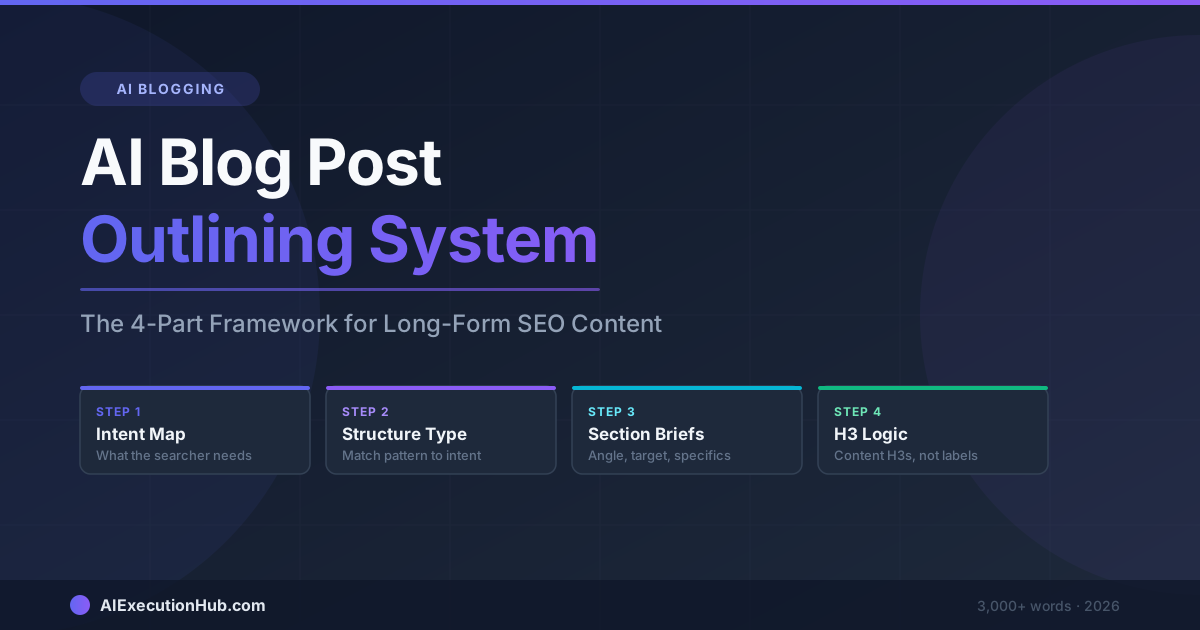
AI Blog Post Outlining System: The 4-Part Framework for Long-Form SEO Content
A practical AI blog post outlining system that structures long-form SEO content before drafting — 4 steps from keyword intent to section briefs that write themselves.
Claude vs ChatGPT for SEO Blogging: A Task-by-Task Verdict
Claude vs ChatGPT for SEO blogging — a task-by-task breakdown of which AI wins for outlines, meta descriptions, tone editing, internal linking, and more.
AI Content Calendar for Niche Sites: A Practical Planning System
Build an AI content calendar for your niche site — keyword clustering, publishing cadence, seasonal timing, and a repeatable monthly planning system.