AI Workflows
AI Content Workflow for Beginners: From Idea to Published Article
A beginner-friendly AI content workflow for SEO research, outlines, drafting, human editing, internal links, Pinterest repurposing, and publishing.
An AI content workflow is not a shortcut for publishing low-quality articles. Used properly, it is a structured process that helps you research faster, organize ideas clearly, draft with less friction, and edit with more focus.
The problem is that many beginners start at the wrong step. They open an AI tool, ask it to "write a blog post about AI side hustles," and then wonder why the result sounds generic.
The issue is not always the tool. The issue is the workflow.
Good content still needs strategy, structure, examples, editing, and a clear reader outcome. AI can support each stage, but it should not replace your judgment.
Quick answer: what is an AI content workflow?
An AI content workflow is a repeatable system for turning an idea into a finished content asset with AI support at specific stages. A strong workflow moves through research, search intent, outline planning, drafting, editing, optimization, internal linking, image planning, Pinterest repurposing, and a clear next step for the reader.
For AIExecutionHub, the goal is not to publish more content at any cost. The goal is to publish useful content that supports topical authority, Pinterest traffic, and beginner-friendly AI execution systems. That matches Google's people-first content guidance: the article should help readers achieve their goal, not exist only to attract search traffic.
AI content workflow at a glance
| Stage | Main goal | AI can help with | Human review should check |
|---|---|---|---|
| Reader problem | Define the reason someone searches | Audience questions and pain points | Specificity and usefulness |
| Search intent | Match the article to the query | SERP angle ideas and subtopics | Intent fit and differentiation |
| Outline | Build the content structure | H2/H3 ideas and FAQ prompts | Logical flow and missing sections |
| Drafting | Write section-by-section | First-pass copy and examples | Accuracy, tone, and depth |
| Editing | Improve quality | Repetition checks and clarity notes | Human usefulness and trust |
| Optimization | Prepare for search | Meta ideas, snippets, image alt text | Natural keyword use |
| Repurposing | Extend reach | Pin titles and descriptions | Brand fit and click relevance |
Step 1: Start with a reader problem, not a keyword alone
Keywords matter, but a keyword is not the same as a content strategy. A keyword tells you what people search. A reader problem tells you why they search.
For example, the keyword "AI side hustles" could attract several readers:
- A beginner looking for realistic online income ideas
- A freelancer looking for a new service offer
- A creator looking for content systems
- A student trying to understand AI business opportunities
- A blogger researching article angles
If you do not choose the reader, your article becomes too broad.
Before drafting, write one clear reader problem:
"A beginner wants to understand practical AI side hustles but does not want hype, fake income screenshots, or complicated tools."
That sentence gives the article direction. It tells you what to include, what to avoid, and what tone to use.
Step 2: Define the article promise
Every strong article makes a promise. The promise should be useful, realistic, and specific.
Weak promise:
"This article will explain AI."
Better promise:
"This article will show beginners how to use AI to plan, draft, edit, and repurpose a professional blog post."
The second promise gives the reader a reason to keep reading. It also gives you a structure for the article.
For SEO content, your article promise should match search intent. If someone searches for "AI content workflow," they likely want a process, not a general opinion piece about AI. Give them the process.
Step 3: Use AI for research, but keep the research controlled
AI can help you brainstorm subtopics, reader questions, search angles, and outline ideas. But research prompts should be specific.
A useful research prompt:
"Act as an SEO content strategist. For the topic 'AI content workflow for beginners,' list the likely reader intent, common beginner questions, subtopics to cover, mistakes to avoid, and practical examples the article should include."
This kind of prompt gives you raw material. It should not become the article. Review it, remove weak ideas, and add your own judgment.
You can also ask AI to identify missing angles:
"What would make this article more useful than a generic AI blogging guide?"
That question often reveals the deeper value: examples, checklists, templates, realistic expectations, and workflow details.
Step 4: Build a search-friendly outline
A strong outline is one of the most important parts of the workflow. It keeps the article readable and helps search engines understand the structure.
Use H2 headings for major sections and H3 headings when a section needs more detail. Avoid clever headings that hide the topic. Clear headings usually perform better for educational SEO content.
A good AI content workflow article might include:
- What an AI content workflow is
- How to choose a reader problem
- How to research with AI
- How to build an outline
- How to draft section by section
- How to edit for quality
- How to repurpose content for Pinterest
- How to connect the article to a resource or offer
The outline should feel like a logical path. The reader should never wonder why a section appears.
Step 5: Draft one section at a time
Do not ask AI to write the whole article in one prompt. Long one-shot drafts often sound repetitive and shallow.
Instead, draft one section at a time. Give AI the article promise, target reader, outline, and specific section goal.
Example section prompt:
"Write the section 'Step 4: Build a search-friendly outline' for a beginner audience. Keep the tone practical and calm. Explain why the outline matters, what headings should do, and how to avoid generic AI content. Include examples."
This keeps the output focused. It also makes editing easier because each section has a defined job.
After drafting, read the section like an editor. Ask:
- Does this answer the reader's question?
- Is the advice specific?
- Is anything exaggerated?
- Can I add a better example?
- Does the section naturally lead to the next one?
Step 6: Edit for human usefulness
Editing is where AI-assisted content becomes professional content.
A strong editing pass should improve:
- Accuracy
- Clarity
- Specificity
- Flow
- Tone
- Examples
- Internal links
- Calls to action
Do not publish content just because it is grammatically clean. A polished article can still be weak if it repeats obvious advice.
Use this editing prompt after your own review:
"Review this article section for clarity, usefulness, repetition, missing examples, and beginner friendliness. Do not rewrite it yet. Give me a prioritized edit list."
This prompt helps you see problems before changing the text. Then you can decide which edits actually improve the article.
Step 7: Optimize the article without keyword stuffing
SEO optimization should make the article easier to understand, not harder to read.
For a beginner AI content workflow article, use natural language around:
- AI content workflow
- AI workflow systems
- AI blogging
- AI creator workflows
- AI productivity systems
- Pinterest repurposing
- SEO article workflow
Good placement usually includes:
- SEO title and meta description
- H1 and early intro
- One or two H2 headings
- Image alt text
- Internal anchor text
- FAQ questions
Avoid repeating the same phrase in every paragraph. Search engines and readers both understand related language.
Step 8: Add internal links with purpose
Internal links help readers continue learning and help search engines understand your content structure. They should feel helpful, not forced.
For example, an article about AI content workflows can link to:
- AI side hustles for beginners
- Pinterest Traffic Engine for AI Creators
- AI Prompt Workflow Checklist
- AI Side Hustle Idea Map
Each link should connect to a real next step. If the reader is learning content workflows, side hustle ideas and Pinterest traffic systems are natural follow-up topics.
Step 9: Repurpose the article for Pinterest
Pinterest is useful for educational content because users search for ideas they can save and revisit. One article can become several Pinterest assets.
For each article, create:
- Five pin title ideas
- Two pin descriptions
- One checklist-style pin angle
- One mistake-focused pin angle
- One resource-led pin angle
Example pin titles for this article:
- AI Content Workflow for Beginners
- How to Write Blog Posts With AI Without Sounding Generic
- AI Blogging Workflow: Research, Draft, Edit, Repurpose
- Beginner AI Content System for Creators
- Simple AI Workflow for SEO Articles
Pinterest repurposing works best when the article has a clear structure. That is another reason workflow-based writing is so useful.
For the description layer specifically — the five-part framework, four content-type formulas, and the reusable AI prompt that batches five variants per article — use the AI Pinterest pin description template as the tactical companion to this repurposing step.
Quality checklist before publishing
Use this checklist before publishing an AI-assisted article.
| Check | Why it matters |
|---|---|
| Reader problem is clear | Keeps the article focused |
| Search intent matches the outline | Reduces bounce and improves satisfaction |
| Each section has a purpose | Prevents filler |
| Examples are specific | Builds trust |
| AI output is edited by a human | Improves accuracy and voice |
| Internal links are helpful | Builds topical authority |
| Images have descriptive alt text | Supports visual discovery |
| CTA matches the reader stage | Improves natural conversion |
If you can check each item, your content is already stronger than most generic AI-generated blog posts.
Connect the article to a resource or offer
Every serious content platform needs a reader journey. A reader lands on an article, learns something useful, and then needs a next step.
That next step might be:
- A free checklist
- A prompt library
- A resource page
- A related article
- A paid ebook
- A service inquiry
For AIExecutionHub, the natural next step for beginners who want the complete system is First $100 With AI. The article teaches part of the workflow. The ebook gives the broader roadmap for turning AI skills into a practical first online income system.
FAQ about AI content workflows
What is an AI content workflow?
An AI content workflow is a repeatable process for researching, outlining, drafting, editing, optimizing, and repurposing content with AI support while keeping human judgment in control.
Can AI write SEO blog posts for beginners?
AI can help beginners draft and organize SEO blog posts, but strong content still needs search intent research, examples, editing, fact-checking, internal links, and a clear reader outcome.
How do you avoid generic AI content?
Avoid generic AI content by starting with a specific reader problem, drafting one section at a time, adding examples, checking claims, editing for usefulness, and removing vague advice.
How can one blog post become Pinterest content?
One blog post can become Pinterest content by turning each major section into pin titles, descriptions, checklist graphics, mistake angles, workflow visuals, and resource-led pins.
What is the first step in an AI content workflow?
The first step is defining the reader problem. A keyword can show demand, but the reader problem explains why the article should exist and what useful outcome it should deliver.
Should AI-generated articles be published without editing?
No. AI-generated drafts should be checked for accuracy, examples, search intent, originality, internal links, tone, and usefulness before publishing.
Final thoughts
AI can make content creation faster, but speed is not the main advantage. The real advantage is structure. When you use AI inside a clear workflow, you can think better, publish more consistently, and create content that supports long-term SEO and Pinterest discovery.
For a deeper end-to-end framework that covers keyword research, briefs, drafting, editing, schema, publishing, and refresh, see the complete AI blogging system.
Once your content is drafted, the SEO optimization step is where most bloggers stall. The guide to automating Yoast SEO meta with AI gives you copy-paste prompt templates for meta titles, descriptions, and focus keyphrases — the part of the workflow that usually gets skipped.
The same structured-prompt approach works beyond blogging. If you serve a healthcare audience or run a clinic, the AI email templates for clinics guide applies this workflow to patient communication — appointment reminders, follow-ups, and reactivation emails built on the same copy-paste prompt format.
If you want to turn this workflow into a broader beginner income system, get First $100 With AI. It shows how to move from AI skills and content ideas into a simple offer, execution workflow, and first-sale plan.
Related AI systems
Continue with connected AI workflow guides.
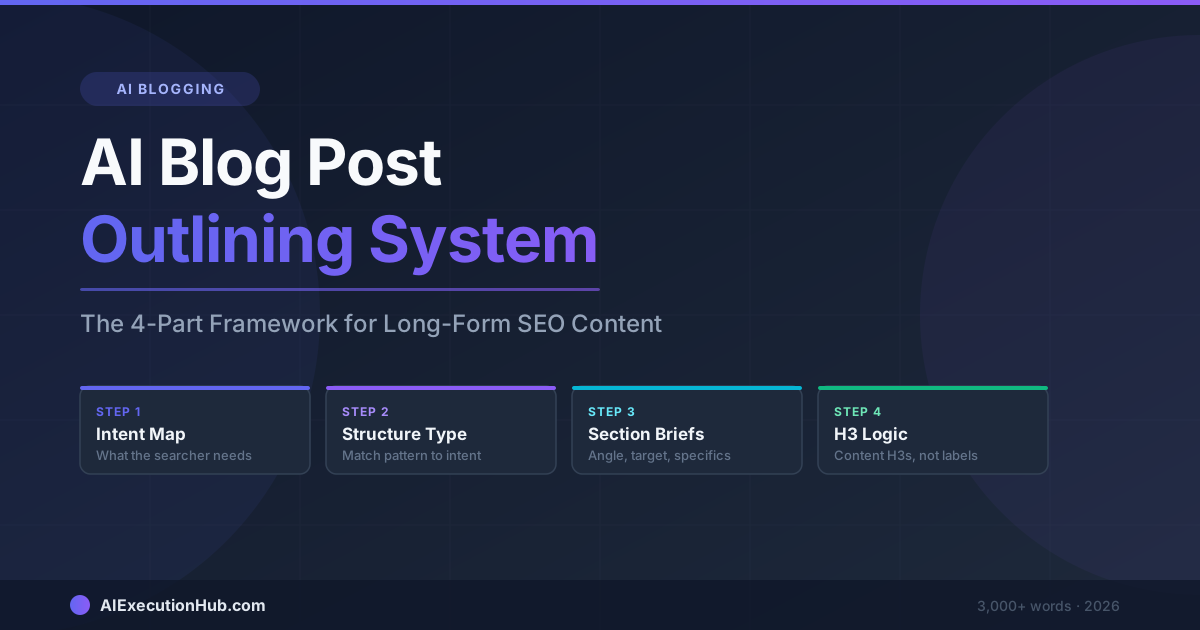
AI Blog Post Outlining System: The 4-Part Framework for Long-Form SEO Content
A practical AI blog post outlining system that structures long-form SEO content before drafting — 4 steps from keyword intent to section briefs that write themselves.
Claude vs ChatGPT for SEO Blogging: A Task-by-Task Verdict
Claude vs ChatGPT for SEO blogging — a task-by-task breakdown of which AI wins for outlines, meta descriptions, tone editing, internal linking, and more.
AI Content Calendar for Niche Sites: A Practical Planning System
Build an AI content calendar for your niche site — keyword clustering, publishing cadence, seasonal timing, and a repeatable monthly planning system.